
Subscribe to continue reading
Subscribe to get access to the rest of this post and other subscriber-only content.

Subscribe to get access to the rest of this post and other subscriber-only content.

My current job, working as the Senior Writer/Editor for a foundation at a land-grant university, involves sharing stories, Tweets, photos, and more on various social media. Most recently, on #GivingTuesday, I was checking out articles on LinkedIn, one of which mentioned “how to get Millennials to donate.” Since two of my children are Millennials in their early 20s, and I volunteer for another local foundation, I clicked on the link.
About 2/3 of the way into the article, I came across a paragraph that compared Millennial philanthropic trends with Baby Boomer trends. I kept reading, waiting to see how Gen Xers felt about philanthropy. Guess what? There was no mention of Gen Xers in the entire article. Zip. Zero. Zilch. So, I became curious. And like a Millennial, I went to Google and typed in Generation X.
Suddenly, a whole new world opened to me. I was born in 1968 and have always considered myself a Gen Xer. With a brother born in ’66 and one in ’75, I’m also the middle child. Coincidentally, Gen Xers are called the Neglected Middle Child, mostly because there are 70 million plus Boomers and 70 million plus Millennials, and there are only 50 million plus Gen Xers. Why the discrepancy? Well, lucky for us, even though the hippies were having a lot of sex, in the early 70s, birth control and legalized abortion helped them have fewer children.
After visiting a few more websites, I found conflicting information regarding the specific dates that designated a person as a Gen Xer. My theory holds at this: Gen Xers were born in between the early 60s and the early 80s. And, similar to astrology, if your birthdate straddles those years, you are said to be on the cusp, or a cusper. So, my uncle John, for instance, who was born in 1965, probably has Boomer and Gen Xer traits.
When I think about my being a Gen Xer, I think about being a child of divorced Boomer parents who needed to “find themselves,” walking everywhere by myself, and being raised on or by television. I often joke that my father (a single parent until I was six) used the TV as a babysitter. Through my research, I discovered I wasn’t alone. Many, if not most, Gen Xers were left home alone with little more than the TV and their siblings to keep them company. It’s probably why we love pop culture!
On a positive note, Gen Xers are independent, resilient, hard-working, and have a sardonic wit. I remember bristling, years ago, when I heard us called the “Slacker Generation.” WTF? When I was 12 I got a paper route. And from that moment on, my father gave me no more spending money. So then I worked as a babysitter. Then as a lifeguard. McDonald’s manager. Nursing home diet aid. Retail sales. Bakery cashier. Then, when I was 20, I joined the navy to get the G.I. Bill because my father wouldn’t help me pay for college.
I’m happy to report we are the generation responsible for creating Hip Hop and paving the way for ethnic diversity. When I think of my childhood, I think of Sesame Street, Captain Kangaroo, and the Electric Company, which we watched in second grade as part of our curriculum. Also, with my father, I watched shows like Good Times, What’s Happening, Laugh In, and the Sonny and Cher Show.
On a negative note, Gen Xers, because we were almost always left alone, referred to as the “latchkey” kids, and were often physically and sexually abused, have become the “most devoted parents in American history.” Some folks call us “helicopter parents.” Guilty as charged. Both of my adult daughters failed out of college, although they grew up watching me bust my butt to earn a BA, an MA, and an MFA, all in writing. I did that without parental support. My daughters have oodles of support. Have I killed their ability to stand on their own?
Anyway: this post is a plea. If you’re a Gen Xer, I want to hear from you! After all, peers are more important to us than parents. I plan to continue my research. If you want to share a story with me, please email me at cindyjoy68@gmail.com.

This is a photo of my son Vinny crossing the finish line at the Down and Dirty Mud Run in Lewiston, Idaho. Vinny is 11, and I had accidentally signed him up for the 4.5 mile race that includes several obstacles, instead of the Mini Mud, which was a four-hour open event where he could simply participate in obstacles. Oops.
A few of my reasons for registering for the event were selfish: I love running, and I wanted to do the 4.5 miler. But mostly, Vinny’s father, whom I’ve been divorced from for five long years works for the group that sponsored the race. I knew Eric would be there, and I wanted to see him. I’m pretty sure he didn’t want to see me. It was Eric who filed for divorce after I admitted to having an affair, a mistake that made him feel tossed aside, insignificant.
Looking back, I thi nk I had the affair because I had been feeling tossed aside and insignificant in the marriage, but didn’t have the skills or faith in Eric to tell him. So, instead, I lit a fire underneath our relationship, which sent him running. I even dated the guy with whom I’d had the affair (it was a disaster), adding insult to Eric’s injury.
It’s only been in the last year that Eric and I have started talking about our breakup. He’s shown me his wounds, and I’ve acknowledged them. I’ve told him numerous times how much I regret the affair, the break up, and that I want him back. He won’t relent.
Eric has said although he’s not ready to be friends, that’s what we should be working toward. Friends. How strange that word sounds. We were friends. Best friends, for twelve years. And yet, we destroyed the foundation on which all good marriages are built. For, if you’re not friends, how can you expect to be lovers? Partners? Soul mates?
A few good sources tell me I should be grateful Eric wants to be friends. I know they’re right. But I feel anxious. Friends to me means no kissing. No intimate hugging. No love making. Ever. And Eric and I were great at those things. We were also great friends who shared secrets, gossip, and personal stories. Still, something in our dynamic made me unwilling to go to him when this guy at work started bugging me. And while I kept the guy at bay for weeks, he finally broke through to the vulnerable, overworked, underappreciated mother who devoured his attention, flirting, and dirty talk. After it was too late, I knew I was headed for disaster.
What keeps me sane right now is that adorable boy in the photo. He’s honest, funny, and cares deeply for everyone in his family, even his circle of friends. Eric and I conceived that boy when we were deeply in love. And though we may not be now, we work hard to get along because we so love him.
I have no idea what the future holds, and it scares me to my core. My sources say I need to live one day at a time. Move the mountain one stone at a time. Breathe. Keep running, one foot in front of the other. Live in the present.

Fifty four years ago today, Marilyn Monroe was found dead in her bedroom from an overdose of pills meant to treat her depression. (Her death was ruled a suicide, as you may know.) I remember the first time I saw an image of Marilyn Monroe: it was on the Child of the 50s comedy album by Robert Klein. At the time, I spent many afternoons in the bedroom with my step uncle “Reggie.” We’ll get to that in a minute.
Reggie introduced me to Cheech and Chong, Robert Klein, Aerosmith, and Rush. During one afternoon while listening to Klein, I studied the album cover as he talked about putting a coin in a vending machine and getting a button with the now famous nude image of Marilyn Monroe. (If you look at my featured image, I’m talking about the two identical pictures just off center to the right in the collage.)
After I was made aware of Marilyn Monroe, I started to hear her name all the time and see images of her in cartoons, advertisements, magazines. There was even a pictorial of her in one of my father’s Playboys, which since I’m a child of the free-wheeling 70s, lay right on the coffee table in our living room.
I was struck dumb by the beauty Marilyn possessed. Sure, her hair was bleached and straightened, nose fixed, but even now, looking at the photos of her when she was simply Norma Jean, I found her breathtaking. My favorite film with her, Niagara, is worth a watch.
Fast forward to my early 20s. I had joined the navy after the death of my beloved older brother, left my hometown Binghamton, New York, and was lucky to get stationed at a weather center in Monterey, California. (Not far from Watsonville where Marilyn had once been named Miss Artichoke.) I visited Hollywood, saw Marilyn’s wax figure, and got the chills when I placed both hands in her hand-prints at Mann’s Chinese Theatre. I loved her.
I started reading books about Marilyn, biographies, anthologies, even an autobiography. She’d been abandoned by her birth mother, just like me. I’d never lived in an orphanage, but had a severely abusive stepmother. Marilyn was raped and sexually abused numerous times during her childhood. I’d never been raped, but Reggie started performing oral sex on me when I was four. His sister also molested me. The more I read about Marilyn and her problems with men, I started to wonder about myself–a woman terrified of commitment who eloped at 21 and dumped the guy three months later. In one book, Marilyn is said to have done the same thing in Mexico. (Some folks says it’s not true, but I believe it.)
Marilyn was unfaithful to every husband and lover. I’ve had many struggles with infidelity as well. The current psychology on childhood sexual abuse tells us this type of behavior is not uncommon–the adult often tries to “work out” or repair what happened to them in the past, and that can lead to repeatedly looking for love in all the wrong places. A very smart writer I met once said, “A kid who’s been sexually abused is the world’s sex object.” The statement is both astute and heartbreaking.
If you’re lucky enough never to have endured sex abuse as a child, it might be difficult to have empathy for people who have. In my life this has been true. I’ve had family members say, “It was experimentation, get over it.” “That’s just an excuse because you were unfaithful.” One callous soul said, “You must have enjoyed it, because you never told your parents.”
Indulge me for a moment if you will. Imagine yourself at four. Or your child at four. (My uncle was 11 when he molested me. Chances are he was molested too, or at the very least exposed to inappropriate behavior.) Reggie bribed me with quarters so I would let him have his way in the bedroom. As I grew older, he gave me record albums or other presents. He said, “Don’t tell your Daddy because he’ll think you’re nasty.” Thank goodness, at age nine, I told him to stop. But the damage had been done.
Over the years, as I learned more about childhood abuse, I grew to feel empathy for Marilyn Monroe. She married for the first time at 16. Although marrying young was not uncommon at the time, I still see it as her getting the hell out of her current situation. In many of the books I’ve read about her, authors describe her as sexually frigid and a woman-child. When I hear “She slept her way to the top,” I prefer to see her not as a soulless woman using sex to get her way, but as a wounded child who believed the promises of men who offered her a better life.
Although I am in my late forties, I am still a hopeful child. Not long ago, I believed the promises of a man, even left my happy marriage. Now, I’m alone and missing my ex-husband and the amazing life we had. I’m grateful for the therapists I’ve had who’ve tried to help me heal from my past. I have a fabulous one now and we’re doing EMDR. It’s not over; and it’s not easy. Today, I wish to say, Rest in peace, Norma Jean. I’ll always be a fan. ❤

Four years ago I was dealt two devastating blows. In April 2012, my divorce became final. Eric, my best friend of 11 years and I could not get over my affair. His anger and my guilt had made communicating nothing but shouting matches. We tried counseling, but whenever the counselor called my cheating partner a “predator,” I got upset. When the counselor asked what I’d gotten from said predator, I answered, “He talked to me. He flirted with me.” Eric said, “If he did it, I won’t.” We were at an impasse.
The worst part was that I never wanted to lose Eric. Some ridiculous part of me believed I could tell him about the affair, he would understand that something had been missing from our marriage, and we would talk it out and fix it together. How arrogant and naive! Eric’s deep hurt came out in anger, and because I couldn’t deal with his emotions or even empathize I turned to the Predator. Big surprise: the union did not last.
Later that year, in October, my father passed away after a sudden illness. I traveled back and forth from my home in Idaho to his in New York to settle his estate. After I returned home for good, Eric came to my house and gave me a hug. (My dad loved him too.) But, it was too late. I’d lost two best friends within six months. 2012 was a bad year.
Here we are in 2016 and guess where I am? Right in the middle of the 5 stages of grief. But it’s not for my father. Of course, I miss him. I loved his angry, sensitive and complicated self. But I’m stuck in the bargaining phase over my other best friend–the one I thought I’d be with forever. “If you take me back, I will never hurt you again.” “You’re the only man I ever loved.” “If we could just work it out, our love will be stronger.”
Big surprise: none of these tactics work. Eric says he’s moved on. I stabbed him in the back. He owes me nothing. He’d rather be alone for the rest of his life than endure that much pain again. Sigh. So, I’m in therapy–trying to stay sane and navigate my life without the love of my life, my best friend. To further complicate matters, Eric and I share an 11 year old son who’s gorgeous, witty, and sensitive. So, there’s no moving away, not seeing Eric, or hiding in my house.
What have I learned? Plenty. But probably the most important lesson is to be honest. Instead of going outside the marriage, I should have turned to Eric and said, “We have some issues. Can we talk about them?” But that would have taken courage. What if he rejected me? Ironic. Perhaps, only perhaps, if I would have taken a leap of faith six years ago and told Eric what I needed. . . Who knows?
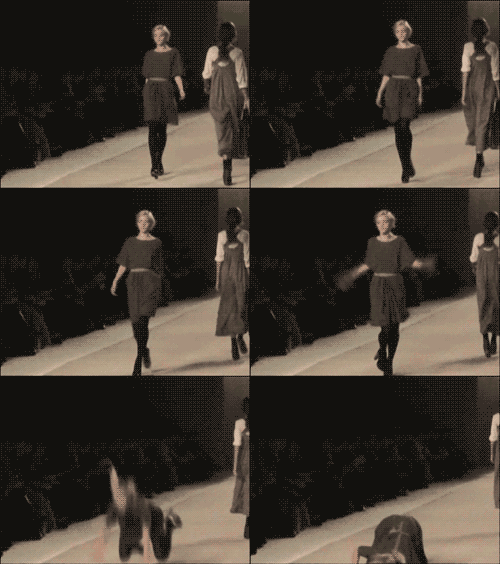
One of the worst jobs I ever had was right after I graduated with my MFA in creative nonfiction. I’d applied as a Chiropractic Assistant (CA) at an office in Moscow, Idaho. The ad promised I’d be writing marketing material, transcribing Dr. X’s notes and working with clients. When I got an interview, I was stoked.
Red flags hit me in the face right after I walked in. All of us interviewees, ranging in age from 17 to 60 plus, were there at the same time: 3:30 p.m. Dr. X and her staff of five CAs introduced themselves. Dr. X, a pale woman in her 60s, had earned a master’s in literature but never found a professorship, so she went into chiropractic medicine. During the interview, Dr. X gave a presentation on light-touch therapy. She mumbled as though she had olives in her mouth.
The second hour of the interview involved writing and editing tests. The other participants were in the room, too, so the process was intimidating and strange. After our assessments, we each met alone with the five staff members. I answered a long list of questions about what kind of team player I would be. No one had told us the interview would last four hours, and I was starving. Needless to say, when I got the call that I was hired, I was stunned.
The 17-year old and the woman in her 20s were hired too. I felt bad for the older women, who I learned later never had a chance. Dr. X did not hire “heavy”, “ugly,” or “old” people. When I discovered I would be making $8.00 an hour with zero benefits, no lunch and a promise of no more than 20 hours per week, I cried. Ten years of education and I was making less than I did as a writing tutor. But my husband was a full-time student and we had two daughters to feed.
My job consisted of watching Dr. X perform light-tough therapy on clients, taking notes, and answering client questions because Dr. X ignored them. She made her money through ridiculously expensive vitamins and new client appointments, which included x-rays. Many clients did not come back, and some of the ones who did asked, “Why am I still in pain?”
I should say that I do believe in chiropractic medicine. As staff members, we received daily adjustments for free, which was a fabulous perk. And it wasn’t all bad: I got to fly to Chicago for a marketing conference, where I found out many business people, who were not chiropractors, owned chiropractic clinics and were getting rich. OK. That wasn’t good.
Dr. X fired the 17-year old because, “He wasn’t fast enough.” She shot me dirty looks every time I talked about something other than work. She also said I was too loud. I do have a deep voice that carries, and I like to laugh. That coupled with some of the stranger techniques I could not get behind, like putting colored sun glasses on clients and using tuning forks over their troubled areas, took their toll. And after several weeks of writing zero marketing materials and getting scowls from Dr. X, I became disenchanted. I still participated in our mandatory prayer circles every morning.
One evening, during a staff meeting (Dr. X did not attend), one of my coworkers said, “Does anyone else notice that Dr. X treats Cindy like crap?” Everyone nodded. And then George, a budding chiropractor who’d worked for Dr. X thirteen years said, “Oh yeah. She always finds a dog to kick around.” The next morning, I called Dr. X and said, “I quit.”
I had never left a job without notice, not even some of the arduous ones from my past, like McDonald’s, U.S. Bank, Subway, and Shari’s Restaurant. Dr. X insisted I come in and work that day, so I did–no sense in stiffing the staff members, whom I really liked. Dr. X ignored me the entire day. And at 5:30 p.m., the staff and I said our good-byes.
Within a week, I landed a job as an administrative assistant to the catering director at a hotel. I made $10.00 an hour with benefits and free lunches. It wasn’t a dream job, but it got me by and paid the bills. My boss there was a delight.
I don’t know about you, but I couldn’t wait to say buh-bye to 2015. It was another year of being single, working my butt off in production more so than writing, and selling the home I had lived in for almost a decade with my former husband and our kids. I spent some time free-lance writing and even submitted work to journals. In April I participated in the poem-a-day movement, and in November, I spent a wonderful weekend with two of my best friends at a writing workshop in Port Townsend. But as Christmas songs played in the dentist office, gas stations and department stores, my optimism fell like a snowflake.
New Year’s Eve was spent with my ten-year-old son Vinny and another best friend, my sister from another mister, Aimee. I’d had a daughter disappointment right before the New Year, which I’d rather not disclose, but believed that 2016 would be a better year! But not long after my holiday vacation ended, I had a personal disappointment. Normally I don’t let life get me down; but when it rains, it pours, and I have lost my umbrella.
Suffice it to say, a blog is a safe space to share. But part of me thinks no one wants to hear my problems. And others tell me that I am the only person who can control my life. I need to make changes. I need to read self-help books. I need to let things go. I need to be honest about my needs. Saying those things and doing them are as different as heat and cold.
And I don’t want to be negative. I want to offer life-affirming tips for dealing with everyday disappointments. But right now, all I have is advice from others. I write to understand my life, so I’ve been working on an “after the divorce” essay and several poems. I’ve been talking to every friend who will listen. I’m sure I’m a real treat.
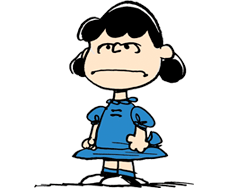
Last week, after hearing of my so-called disappointments, I turned into a Peanuts character, walking along the street with my head down. While kicking a stone, the toe of my boot stuck to the sidewalk and I fell face-first on the concrete. I cracked the glass on the front of my iPhone and my ego. It was the perfect end to a perfect week.
On a bright note, I finished a book called What Shamu Taught Me About Life, Love and Marriage by Amy Sutherland. What a pleasure it was to read. Sutherland talks about positive reinforcement and rewarding behavior–stuff from psych 101, but with real life examples. She observed aspiring animal trainers that work with predators, ones that can tear arms off or kill people with a bite to the neck.
Basically I learned to ignore bad behavior, a daughter screaming in my face, or a client criticizing my brochure, and reward good behavior: Thank you for picking up your dirty socks, Daughter, and Thank you, Client, for your feedback. I’m writing this in its simplest form, but feel free to check it out yourself. I’m going to reread the book.
My plan moving ahead, and you know I have one, is to dress for success, support, not enable, my daughters, and build character in my son. I will breathe deeply before walking into a difficult situation, smile when I don’t feel like smiling, and write as much as possible. Let’s hope February is a better month.

My daughter Jessica was still crawling at 15 months. Because other toddlers I knew had already started taking their wobbly first steps, I called the pediatrician. He said, “If she doesn’t start walking by next month, bring her in. We’ll put braces on her legs.” Jessica started walking that week. And because I now know that she gets embarrassed over everything, I’m sure Jessica overheard the doctor and was afraid of looking like Forrest Gump.
In kindergarten, Jessica tested into a program called Enrichment–what some schools call “Gifted and Talented,” because she knew how to read. Jessica was not the type of student to push herself when she was bored, and I suspected this program would encourage that. I was feeling pretty good about myself and Jessica’s father–a meteorologist for the U.S. navy–that we had drawn the long straw. We had a smart kid.
When Jessica entered 4th grade, it was the first time I interacted with the parents of other “smart kids.” At the time, I was a 32-year-old grad student in English at the university in Bellingham, Washington. It was five p.m., and when I walked into the elementary school library for the parents’ meeting, Jessica holding one hand and my five-year-old daughter, Josie, the other, I felt like a kid. No other parents had brought their kids, and they all had gray hair and wrinkles. They were dressed in blazers and slacks. I was a grad student in a sweater and ripped jeans.
The atmosphere in the library bugged me–the sense of smugness in the air. Every couple sat with their noses held high, discussing the curriculum, talking about art programs their kids were involved in, or awards they’d received. They talked about math olympics, writing contests, music lessons, physics and future problem solvers of America. I kept quiet, thinking about how grateful I was simply to have Jessica in the program. These parents seemed to believe that their smart kids were a reflection of their own intelligence.
One of the reasons I was so pleased to see Jessica succeed academically was because I hadn’t. I wasn’t dumb, but education wasn’t valued in my childhood household. My father owned a shoe repair shop. He was funny, friendly and blessed with common sense. When I was in high school, my father told me: “Just get Cs, and I’ll be happy.” So I learned that I had to care about doing well for myself. I only put forth effort in the classes I liked: art, theatre and English. And I didn’t start college until I was 24.
Jessica quit the Gifted and Talented program in 7th grade–when it was no longer mandatory. I begged her to stay in. “I don’t want people to think I’m a geek,” she said. She wouldn’t believe me when I told her: “You can’t control what people think.” Within a year, her grades tanked. Boys and parties became much more important than solving America’s problems, writing poetry or competing in math. By this time, I had finished my graduate degree and was working as a writer. When Jessica failed freshman English, I figured she was rebelling against me.
My smart kid graduated from high school with a 1.67 GPA. Her father gave her his G.I. bill money so she could attend community college. She loved it, but failed out after a bad breakup during her third quarter. Jessica took a year off and is back in college, working part time as a waitress. Like a lot of us, she regrets not trying harder when she had the chance. She even says, “Mom, you should have pushed me harder. But when I was in those classes, I felt like the dumbest kid there.”
As a parent, you never know how well you are doing. At best, raising kids ebbs and flows as continuously as the tide. Jessica crawled for 15 months and I never worried until I noticed other kids “beating” her. Competition makes us crazy. A poetry teacher told me once: “Comparing yourself to others is deadly.” I say it’s also inevitable. Perhaps it keeps us ambitious. Aware. After all, competition made me call the doctor.

With my father, just one bite of fresh fish, and he said he felt his throat closing. With my younger brother, just one bite of a walnut cookie, and he said he felt like he had worms on his tongue. And now, with my son Vinny, just one bite of some nutty bread, and he said, “My mouth started burning.”
Within twenty minutes, Vinny was covered in hives. The babysitter called Vinny’s father Eric who rushed to the house and read the bread’s ingredients: walnuts, almonds, pecans. He injected Vinny with the Epi-Pen and drove him to the ER, calling me on the way. When I showed up, Vinny was still awake, high on the epinephrine, playing with the hospital’s Ipad. I called the babysitter’s parents, who are Vinny’s godparents. They came right over.
The doctor gave Vinny an IV of Benadryl, also put him on oxygen, because he’s a mouth breather, and gave him the nebulizer. Soon Vinny passed out. His entire body, even his head, was covered in hives. For us, it was two-plus hours of hand wringing before he woke back up, looked better, and was “out of the woods.” His godparents stayed with Eric and me the entire day, their eyes wide, their repeated phrase, “We never knew it was this serious.”
Vinny was admitted over night just in case. He is nine, and this was his fourth trip to the ER.
1. At one year old, Vinny’s grandmother fed him a chocolate chip cookie with walnuts. He threw up, broke out into hives, and Eric rushed him to the ER. That’s when we learned he was allergic to tree nuts.
2. In kindergarten, even though we told the teacher Vinny couldn’t eat food brought from other peoples’ homes, during a holiday party, he ate a chocolate chip cookie. It was right before Eric came to get him. Vinny threw up and broke out into hives. Eric gave him the Epi-Pen on the way to the ER. The next day I went to the school and raised a little hell with the teacher.
3. For Christmas when Vinny was 7, a friend bought me a basket full of candy, nuts and other treats. I threw just about everything away, save two pieces of toffee, which I had no idea contained almonds. Vinny ate a piece of toffee. He almost died that time, and Eric said it was all my fault. I suppose it was.
Each time Vinny goes into anaphylactic shock, the reaction becomes quicker and more severe. This last time I started thinking about his future. Eric and I can’t hover around our son his entire life. The doctor recommended that Vinny learn to give himself the Epi-Pen shot. He knows how. But would you want to stick a needle in your leg and hold it for ten seconds?
Only 1 percent of the population is allergic to tree nuts. My father, my brother, my son. Not me, Eric, my daughters. Being a parent is stressful enough without the added worry of a life-threatening allergy. Vinny’s godparents now understand the gravity of his nut allergy. They are kind and intelligent people. They even offered to pay part of the hospital bill.
Eric and I will continue to watch over our son as long as we can and encourage him to be an active participant in his own health. We keep telling him to read the labels, only eat food that comes from a package with legible ingredients, and no strange bread. Not even one bite.
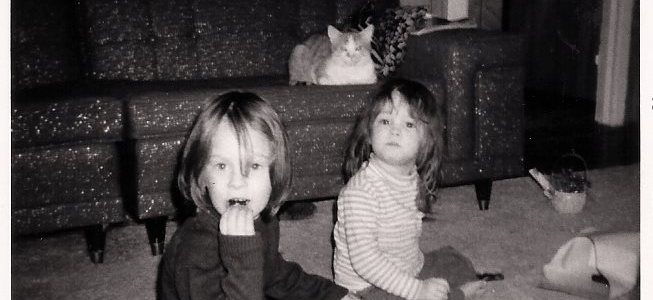
HAZEL STREET – From Chapter One of the memoir The Cobbler’s Daughter
Click. I wake to the sound of the light switch. I sit up, look out the hallway windows and see it’s still dark.
“Come on, kids,” my father says, standing by our bed. His black hair is combed back from his face. “We’re going bowling.”
“What time is it?” my brother Tony asks, rubbing his eyes.
My father smiles. “What are you, a cop?”
Tony and I crawl out of bed. We pull on T-shirts and jeans. I don’t remember if we brush our teeth or wash our faces. I doubt we brush our hair.
We drive across town to Brandywine Bowl where a bunch of my father’s friends are already waiting. Inside the walls are cream-colored, the lanes are wood, and everything else is harvest gold. The carpet is a vast ocean of blue.
Before my father joins his friends, he hands Tony a wad of dollar bills and says “Go get something to eat.” We run to the snack shop. It’s like a dream: Wise potato chips, Slim Jims, City Chicken (Turkey on a Stick), French fries, Cokes. We even have enough left over for the pinball machine.
High on soda, Tony and I chase each other back and forth through the nearly empty building. If we bother my father, he throws us more money. We eat and play to our hearts’ delight. We stay until the Pepsi clock reads 1:00 a.m. My father hands back his shoes. Drops his ball in his bag and we leave.
I squeeze in between him and Tony in the front seat of his 1965 red Chrysler Corvair convertible. My hair blows in the wind—free and loose.
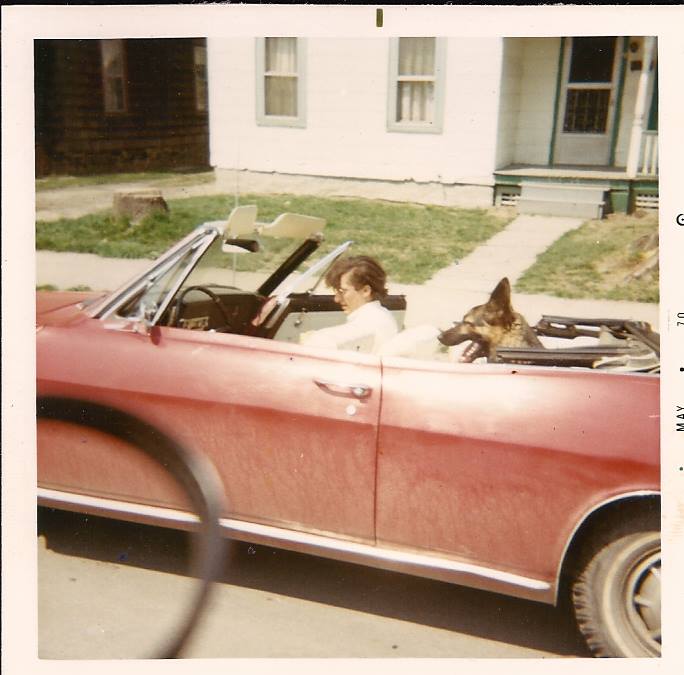
 The Cobbler's Daughter