
Subscribe to continue reading
Subscribe to get access to the rest of this post and other subscriber-only content.
Subscribe to get access to the rest of this post and other subscriber-only content.

Subscribe to get access to the rest of this post and other subscriber-only content.
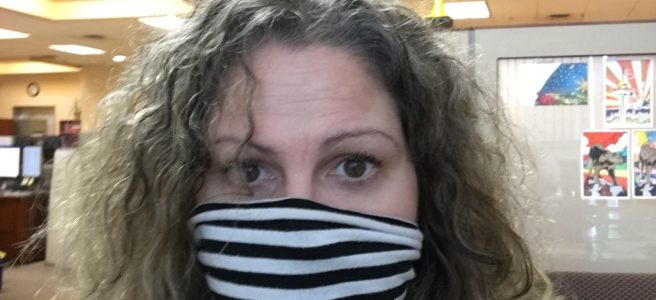
For the past couple of years, I have been working in earnest on my memoir, named like this blog: The Cobbler’s Daughter. Loyal readers, and beloved editors from LCSC, WWU, and UI, you probably know that it is a childhood memoir, involving the very close relationship I had with my older brother Tony. Here we are in my father’s store, The Leather Shoe Shop, around 1971. We are five and three.
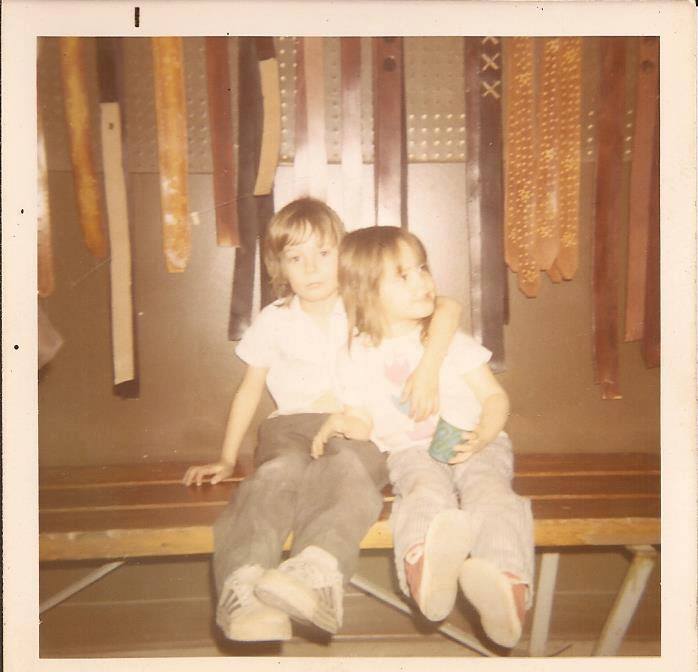
I love that Tony has his arm around me, because this is how I remember him–big brother, protector, always close. And that’s why it is taking me so long to finish the book. My brother was also troubled–and I don’t want to give away too much, because I’m going to want you to read the book once it’s finished. Let’s just say, we grew up in the 70s, and the full title is The Cobbler’s Daughter: A Gen X Memoir of Sex, Drugs, and Rock ‘n Roll.
Please be patient with me, dear friends, and know, I will return to this blog with more current events. Right now, I’m kind of stuck in the past.
All my love, Cindy
In 1997, I was a junior in Humanities at Lewis-Clark State College in Lewiston, Idaho. The journalism program was defunct, and since I had just become a 27-year-old widow with two young daughters, I switched to creative writing and enrolled in my first creative nonfiction class. I just wanted to learn how to write.
I wrote my first nonfiction piece when I was about five. It was a typed paragraph, and the paper I used ended up with a small coffee stain in the right corner. The text read something like, “I asked my father for money, but because we don’t have a lot, he said no. But at least I have a new mother, and I love her!!!!!” My father found and folded the letter, and hid it in his safe for years. In 1989, when I was in the navy, he sent me the letter with a sticky note that said, “I hope you still feel the same.”
At age 20, I did not feel the same. As a matter for fact, after my beloved older brother Tony was killed in a motorcycle accident in 1987, my father turned to his wife not me, to grieve. I blamed his wife for Tony’s death. She had been an abusive monster when we were growing up. My brother turned to drinking and drugs, I turned to men. The night my brother died, my grief trickled out into absolute hatred for my stepmother.
I mention the letter because it shows how long I’ve been in love with writing “the truth.” As I came of age, even when I wrote fiction, I used the first person “I” and described events from my actual life. Write what you know they say. As a teenager, I knew blackheads, bullying, and boys. If my stepmother had ever caught me writing negative things about her, she would have shown them to my father and I would have been punished. I was the “big mouth” who complained all the time.
When I was 13, a woman I babysat for gave me the memoir Mommie Dearest by Christina Crawford, actress Joan Crawford’s adopted daughter. My life was never the same. Mommie Dearest is an expose on child abuse. Christina’s biological mother had given her up (just as mine did) and she was being beaten, ridiculed, and shamed by her “new” mother. I had no idea that other kids suffered abuse. No one at school EVER talked about it, and when I told Tony our stepmother was mean,” he said, “Shut up. Dad doesn’t need to hear that shit.”
By the time I was in college, and had gone on to graduate school, writing my “truth” left some of my colleagues unsettled. “How can you write such nasty things about your family?” they asked. I wrote the truth, nasty or not. And since my father had divorced my stepmother in 1998 and she lived 3000 miles away, I felt somewhat safe. Writing about people who hurt us is no new debate. If you’ve read This Boy’s Life, The Liar’s Club, Hungry for the World, or Mommie Dearest, imagine the criticism those authors faced.
If anyone cares to know, writing nonfiction for me is telling the truth of my experience to the best of my memory. My father once paid me an enormous compliment after reading my work, and I keep that in mind when I write. He said, “I remember it differently, but those are your memories.” For a man with a high school education and shoe-repair man’s apprenticeship, I thought he sounded damned professorial.
And speaking of professors, my first writing teacher, who is also a dear friend and mentor, once said, “No one is all evil or all good. You have to show them as a rounded human being.” Believe it or not, rounding out my stepmother is not that difficult. Writing about my brother Tony, however, whom I worshipped until the day he died, that’s a whole other story. I was his patsy, his sidekick, Laurel to his Hardy. One day, I may sit down and write the truth of our story. But I’m still working on it —
I grew up with a father who loathed dishonesty. I credit his Italian American pride, or perhaps growing up catholic, but nothing made my father angrier than learning he’d been lied to. He tended to be “brutally honest,” and the people who loved and admired him appreciated that. As his daughter, I feared his truth-telling when I was as a girl because I was extremely sensitive, but eventually I grew to admire the trait.
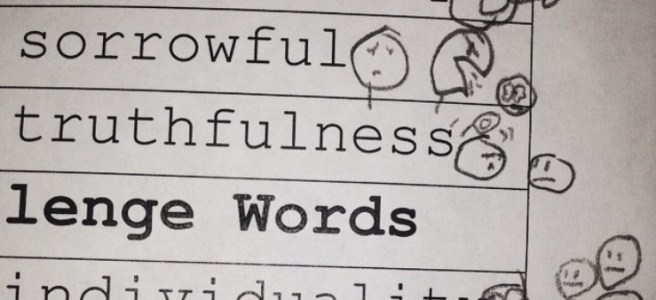
You have to be courageous, confident, and often live with regret when you are honest, because people rarely want to hear the truth. The image I’ve included in this post is a sketch from my son. In order to remember his spelling words, he sketched faces beside them expressing what he believed conveyed the word. When you look at the faces beside “truthfulness,” although one wears a halo, they both look anxious. Telling the truth is hard; hearing the truth is hard.
My father once told me, “You couldn’t be more like me if you tried.” Although I was sincerely flattered to hear that, I knew it meant I am also brutally honest, have a terrible poker face, and tend to alienate people because I struggle with being dishonest even in polite conversation when sometimes you should be. This is not to say I have never told a lie. I have. And some have caused irreparable damage in my life. It’s just that lying to people causes me great internal struggle, reddens my face, and fills me with crippling guilt.
Similar to most people, it’s also not easy for me to hear the truth. When people have told me I’m too analytical, sensitive, dramatic, or that I remember more negative details than positive, I stiffen with defensiveness. All of the preceding statements are true. I am also self-deprecating, affectionate, and loyal. The older I get the kinder I am to myself (and others), and I try to work with not against my human flaws.
One of my most irritating traits, I’m guessing because I’ve received a lot of flack for it, is my incurable need to discover the “why” behind just about everything. Why did my mother leave? Why did my stepmother beat me? Why do dishonest people seem to have more success than honest ones? Why did my brother get killed? Why did my husband die? Why do I have so much trouble sustaining a romantic relationship when others seem to just do it? Why are people mean? Why I did reject the man I believe is my true love?
On a positive note, once I process the Why in my head, through writing, art, or talking, I can usually let it go. In some cases, like with the death of my brother, I’ve had to make peace with not knowing why it happened. That has taken 30 years. I’m still struggling with the true love question. The other whys might be explained with psychology, self-help books, chats with friends, or talk therapy–of which I’m a huge advocate. But one important lesson I’ve learned is that in order to process these questions and heal, you have to be 100% truthful.
In the book, The Courage to Heal, which I highly recommend if you’ve suffered any personal trauma, the word courage is aptly used. It’s so much easier, and fun, to ignore our flawed humanness and not heal. For years, I was the party girl, loved getting drunk, being around people, being loud and obnoxious, all in an effort not to spend time alone and seek the truth within myself. I’d gone to therapy, but never engaged fully with the tenets. It took my loving someone other than myself to see how badly I needed help.
This person is still in my life, and because we’ve hurt each other, we have had to start rebuilding trust from the bottom up. Being honest takes courage, confidence, and working through regret to move forward when we hurt each other now. But, as you’ve probably heard or experienced, there is no greater reward than having an honest, open relationship with someone you love. And I want that.
My current job, working as the Senior Writer/Editor for a foundation at a land-grant university, involves sharing stories, Tweets, photos, and more on various social media. Most recently, on #GivingTuesday, I was checking out articles on LinkedIn, one of which mentioned “how to get Millennials to donate.” Since two of my children are Millennials in their early 20s, and I volunteer for another local foundation, I clicked on the link.
About 2/3 of the way into the article, I came across a paragraph that compared Millennial philanthropic trends with Baby Boomer trends. I kept reading, waiting to see how Gen Xers felt about philanthropy. Guess what? There was no mention of Gen Xers in the entire article. Zip. Zero. Zilch. So, I became curious. And like a Millennial, I went to Google and typed in Generation X.
Suddenly, a whole new world opened to me. I was born in 1968 and have always considered myself a Gen Xer. With a brother born in ’66 and one in ’75, I’m also the middle child. Coincidentally, Gen Xers are called the Neglected Middle Child, mostly because there are 70 million plus Boomers and 70 million plus Millennials, and there are only 50 million plus Gen Xers. Why the discrepancy? Well, lucky for us, even though the hippies were having a lot of sex, in the early 70s, birth control and legalized abortion helped them have fewer children.
After visiting a few more websites, I found conflicting information regarding the specific dates that designated a person as a Gen Xer. My theory holds at this: Gen Xers were born in between the early 60s and the early 80s. And, similar to astrology, if your birthdate straddles those years, you are said to be on the cusp, or a cusper. So, my uncle John, for instance, who was born in 1965, probably has Boomer and Gen Xer traits.
When I think about my being a Gen Xer, I think about being a child of divorced Boomer parents who needed to “find themselves,” walking everywhere by myself, and being raised on or by television. I often joke that my father (a single parent until I was six) used the TV as a babysitter. Through my research, I discovered I wasn’t alone. Many, if not most, Gen Xers were left home alone with little more than the TV and their siblings to keep them company. It’s probably why we love pop culture!
On a positive note, Gen Xers are independent, resilient, hard-working, and have a sardonic wit. I remember bristling, years ago, when I heard us called the “Slacker Generation.” WTF? When I was 12 I got a paper route. And from that moment on, my father gave me no more spending money. So then I worked as a babysitter. Then as a lifeguard. McDonald’s manager. Nursing home diet aid. Retail sales. Bakery cashier. Then, when I was 20, I joined the navy to get the G.I. Bill because my father wouldn’t help me pay for college.
I’m happy to report we are the generation responsible for creating Hip Hop and paving the way for ethnic diversity. When I think of my childhood, I think of Sesame Street, Captain Kangaroo, and the Electric Company, which we watched in second grade as part of our curriculum. Also, with my father, I watched shows like Good Times, What’s Happening, Laugh In, and the Sonny and Cher Show.
On a negative note, Gen Xers, because we were almost always left alone, referred to as the “latchkey” kids, and were often physically and sexually abused, have become the “most devoted parents in American history.” Some folks call us “helicopter parents.” Guilty as charged. Both of my adult daughters failed out of college, although they grew up watching me bust my butt to earn a BA, an MA, and an MFA, all in writing. I did that without parental support. My daughters have oodles of support. Have I killed their ability to stand on their own?
Anyway: this post is a plea. If you’re a Gen Xer, I want to hear from you! After all, peers are more important to us than parents. I plan to continue my research. If you want to share a story with me, please email me at cindyjoy68@gmail.com.
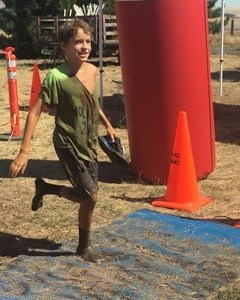
This is a photo of my son Vinny crossing the finish line at the Down and Dirty Mud Run in Lewiston, Idaho. Vinny is 11, and I had accidentally signed him up for the 4.5 mile race that includes several obstacles, instead of the Mini Mud, which was a four-hour open event where he could simply participate in obstacles. Oops.
A few of my reasons for registering for the event were selfish: I love running, and I wanted to do the 4.5 miler. But mostly, Vinny’s father, whom I’ve been divorced from for five long years works for the group that sponsored the race. I knew Eric would be there, and I wanted to see him. I’m pretty sure he didn’t want to see me. It was Eric who filed for divorce after I admitted to having an affair, a mistake that made him feel tossed aside, insignificant.
Looking back, I thi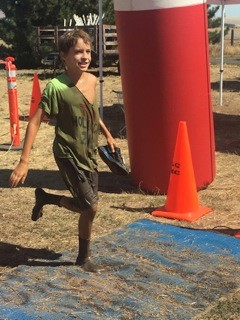 nk I had the affair because I had been feeling tossed aside and insignificant in the marriage, but didn’t have the skills or faith in Eric to tell him. So, instead, I lit a fire underneath our relationship, which sent him running. I even dated the guy with whom I’d had the affair (it was a disaster), adding insult to Eric’s injury.
It’s only been in the last year that Eric and I have started talking about our breakup. He’s shown me his wounds, and I’ve acknowledged them. I’ve told him numerous times how much I regret the affair, the break up, and that I want him back. He won’t relent.
Eric has said although he’s not ready to be friends, that’s what we should be working toward. Friends. How strange that word sounds. We were friends. Best friends, for twelve years. And yet, we destroyed the foundation on which all good marriages are built. For, if you’re not friends, how can you expect to be lovers? Partners? Soul mates?
A few good sources tell me I should be grateful Eric wants to be friends. I know they’re right. But I feel anxious. Friends to me means no kissing. No intimate hugging. No love making. Ever. And Eric and I were great at those things. We were also great friends who shared secrets, gossip, and personal stories. Still, something in our dynamic made me unwilling to go to him when this guy at work started bugging me. And while I kept the guy at bay for weeks, he finally broke through to the vulnerable, overworked, underappreciated mother who devoured his attention, flirting, and dirty talk. After it was too late, I knew I was headed for disaster.
What keeps me sane right now is that adorable boy in the photo. He’s honest, funny, and cares deeply for everyone in his family, even his circle of friends. Eric and I conceived that boy when we were deeply in love. And though we may not be now, we work hard to get along because we so love him.
I have no idea what the future holds, and it scares me to my core. My sources say I need to live one day at a time. Move the mountain one stone at a time. Breathe. Keep running, one foot in front of the other. Live in the present.
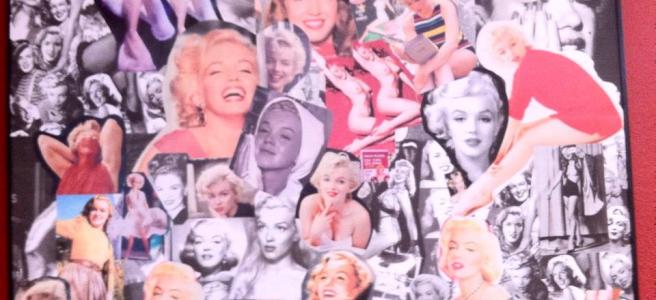
Fifty four years ago today, Marilyn Monroe was found dead in her bedroom from an overdose of pills meant to treat her depression. (Her death was ruled a suicide, as you may know.) I remember the first time I saw an image of Marilyn Monroe: it was on the Child of the 50s comedy album by Robert Klein. At the time, I spent many afternoons in the bedroom with my step uncle “Reggie.” We’ll get to that in a minute.
Reggie introduced me to Cheech and Chong, Robert Klein, Aerosmith, and Rush. During one afternoon while listening to Klein, I studied the album cover as he talked about putting a coin in a vending machine and getting a button with the now famous nude image of Marilyn Monroe. (If you look at my featured image, I’m talking about the two identical pictures just off center to the right in the collage.)
After I was made aware of Marilyn Monroe, I started to hear her name all the time and see images of her in cartoons, advertisements, magazines. There was even a pictorial of her in one of my father’s Playboys, which since I’m a child of the free-wheeling 70s, lay right on the coffee table in our living room.
I was struck dumb by the beauty Marilyn possessed. Sure, her hair was bleached and straightened, nose fixed, but even now, looking at the photos of her when she was simply Norma Jean, I found her breathtaking. My favorite film with her, Niagara, is worth a watch.
Fast forward to my early 20s. I had joined the navy after the death of my beloved older brother, left my hometown Binghamton, New York, and was lucky to get stationed at a weather center in Monterey, California. (Not far from Watsonville where Marilyn had once been named Miss Artichoke.) I visited Hollywood, saw Marilyn’s wax figure, and got the chills when I placed both hands in her hand-prints at Mann’s Chinese Theatre. I loved her.
I started reading books about Marilyn, biographies, anthologies, even an autobiography. She’d been abandoned by her birth mother, just like me. I’d never lived in an orphanage, but had a severely abusive stepmother. Marilyn was raped and sexually abused numerous times during her childhood. I’d never been raped, but Reggie started performing oral sex on me when I was four. His sister also molested me. The more I read about Marilyn and her problems with men, I started to wonder about myself–a woman terrified of commitment who eloped at 21 and dumped the guy three months later. In one book, Marilyn is said to have done the same thing in Mexico. (Some folks says it’s not true, but I believe it.)
Marilyn was unfaithful to every husband and lover. I’ve had many struggles with infidelity as well. The current psychology on childhood sexual abuse tells us this type of behavior is not uncommon–the adult often tries to “work out” or repair what happened to them in the past, and that can lead to repeatedly looking for love in all the wrong places. A very smart writer I met once said, “A kid who’s been sexually abused is the world’s sex object.” The statement is both astute and heartbreaking.
If you’re lucky enough never to have endured sex abuse as a child, it might be difficult to have empathy for people who have. In my life this has been true. I’ve had family members say, “It was experimentation, get over it.” “That’s just an excuse because you were unfaithful.” One callous soul said, “You must have enjoyed it, because you never told your parents.”
Indulge me for a moment if you will. Imagine yourself at four. Or your child at four. (My uncle was 11 when he molested me. Chances are he was molested too, or at the very least exposed to inappropriate behavior.) Reggie bribed me with quarters so I would let him have his way in the bedroom. As I grew older, he gave me record albums or other presents. He said, “Don’t tell your Daddy because he’ll think you’re nasty.” Thank goodness, at age nine, I told him to stop. But the damage had been done.
Over the years, as I learned more about childhood abuse, I grew to feel empathy for Marilyn Monroe. She married for the first time at 16. Although marrying young was not uncommon at the time, I still see it as her getting the hell out of her current situation. In many of the books I’ve read about her, authors describe her as sexually frigid and a woman-child. When I hear “She slept her way to the top,” I prefer to see her not as a soulless woman using sex to get her way, but as a wounded child who believed the promises of men who offered her a better life.
Although I am in my late forties, I am still a hopeful child. Not long ago, I believed the promises of a man, even left my happy marriage. Now, I’m alone and missing my ex-husband and the amazing life we had. I’m grateful for the therapists I’ve had who’ve tried to help me heal from my past. I have a fabulous one now and we’re doing EMDR. It’s not over; and it’s not easy. Today, I wish to say, Rest in peace, Norma Jean. I’ll always be a fan. ❤

Four years ago I was dealt two devastating blows. In April 2012, my divorce became final. Eric, my best friend of 11 years and I could not get over my affair. His anger and my guilt had made communicating nothing but shouting matches. We tried counseling, but whenever the counselor called my cheating partner a “predator,” I got upset. When the counselor asked what I’d gotten from said predator, I answered, “He talked to me. He flirted with me.” Eric said, “If he did it, I won’t.” We were at an impasse.
The worst part was that I never wanted to lose Eric. Some ridiculous part of me believed I could tell him about the affair, he would understand that something had been missing from our marriage, and we would talk it out and fix it together. How arrogant and naive! Eric’s deep hurt came out in anger, and because I couldn’t deal with his emotions or even empathize I turned to the Predator. Big surprise: the union did not last.
Later that year, in October, my father passed away after a sudden illness. I traveled back and forth from my home in Idaho to his in New York to settle his estate. After I returned home for good, Eric came to my house and gave me a hug. (My dad loved him too.) But, it was too late. I’d lost two best friends within six months. 2012 was a bad year.
Here we are in 2016 and guess where I am? Right in the middle of the 5 stages of grief. But it’s not for my father. Of course, I miss him. I loved his angry, sensitive and complicated self. But I’m stuck in the bargaining phase over my other best friend–the one I thought I’d be with forever. “If you take me back, I will never hurt you again.” “You’re the only man I ever loved.” “If we could just work it out, our love will be stronger.”
Big surprise: none of these tactics work. Eric says he’s moved on. I stabbed him in the back. He owes me nothing. He’d rather be alone for the rest of his life than endure that much pain again. Sigh. So, I’m in therapy–trying to stay sane and navigate my life without the love of my life, my best friend. To further complicate matters, Eric and I share an 11 year old son who’s gorgeous, witty, and sensitive. So, there’s no moving away, not seeing Eric, or hiding in my house.
What have I learned? Plenty. But probably the most important lesson is to be honest. Instead of going outside the marriage, I should have turned to Eric and said, “We have some issues. Can we talk about them?” But that would have taken courage. What if he rejected me? Ironic. Perhaps, only perhaps, if I would have taken a leap of faith six years ago and told Eric what I needed. . . Who knows?
Love is Blind
When my father met Vickie, a bleach blond
hourglass in a red plaid dress cut across her thighs
and red platform heels, my brother and I
were tucked away like out-of-style clothing.
Vickie was 16, my father 26, and she moved right in,
pranced around in halter-tops, bending to reveal
the quarter-moon of her breast. My father took Vickie
to fancy dinners and movies, while my brother and I
stayed home with babysitters in tie-dyed T-shirts,
who smoked pot, drank Budweiser, touched tongues.
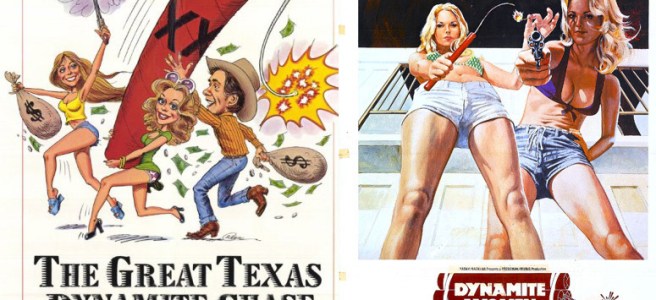
We watched R-rated movies like The Great Texas Dynamite Chase:
heavily made-up women with silky hair, skinny
arms and legs, writhing under the covers on either
side of a spindly man with feathered hair and a mustache.
And Beyond the Door, where the devil impregnates
the woman from Nanny and the Professor. She eats garbage,
throws up green liquid, has a baby with no mouth—
if only that would have happened to Vickie,
whose every other word was “fuck,” insisted we call her Mom,
drove us to her ex-boyfriend’s house, had us wait
in the car while she vanished for an hour doing who
knows what. There was nothing my brother and I could do—
our father, in a leather vest and bell bottoms, zip-up
boots, had his ears turned off, brain shut down,
eyes pecked, sockets cleaned out, leaving two black holes.
 The Cobbler's Daughter