Emotions Just Are

When I was in second grade, I was using a stapler and pushed a staple into my index finger. As soon as I saw the pearls of blood, I started to cry. My teacher, Mrs. Blabac,  walked over to help me. A few classmates circled and called me Cry Baby. I cried harder. At the end of that year, in my report card, Mrs. Blabac wrote: “You’re sensitive. Never lose that trait.”

As far as I can remember, no one has ever praised me for being sensitive besides Mrs. Blabac. At home, my father preferred the smiling, happy Cindy. My brother Tony was stoic and level, and I was an open book whether I was happy, sad, angry, or excited. If my father caught me crying, he sent me to my bedroom.

All through elementary school and even into middle school, the name Cry Baby stuck. No one showed me how to manage my emotions, or explained that emotions just are. It’s taken me decades of therapy to figure that out. And, I am still learning how to manage the slew of emotions that stir inside me. One therapist said, “You have a lot of emotions.” Do I?

One thing I have realized is that the more a person is uncomfortable with their own emotions, the more he or she detests the expression of someone else’s. I have been called “dramatic” “psycho” “bi-polar” and more. Although I am not someone who can pretend that everything is okay, I am a person who wishes to be open and honest. Sometimes that means “emotional,” and that upsets some people.

By the time I got to high school, I learned only to show the smiling, happy Cindy. People preferred that girl. I even earned the notable Class Smile. Looking back, I know I was a relatively happy kid, and at the same time, I was hiding the fact I was part of an insanely dysfunctional family with an alcoholic father, abusive stepmother, and two brothers who acted out in the most outrageous ways. Tony got into fist fights, and Jack got kicked out of every elementary school in our district. And me? I was a girl “looking for love in all the wrong places.”

My current therapist told me “emotions are not bad or good–they just are.” I love that. Many people view anger and sadness as bad, and happiness and joy as good. But are they? When I’m sad, I make bad decisions. When I’m happy, I make bad decisions. Noted EQ guru Travis Bradberry advises us not to make any decisions when we are really happy or really sad. Emotions are temporary.

All of that said, I recommend we follow our hearts.



Red Flags Schmed Flags

When I was 32, I attended graduate school in Bellingham, Washington, at Western Washington University. Go Vikings! Part of my graduate program included working as an English Composition Instructor. It was one of the best jobs I have ever had, and I truly enjoyed interacting with first year college students. Part of my responsibilities included meeting with students one-on-one to talk about their assignments, college, and the writing process.

By this time in my life, I’d been married, divorced and widowed, and had two daughters. I still believed in love and everything, however, sometimes I had to check myself when I met with students who were 18 and had unbridled hope regarding the world that awaited them. One young woman I’ll never forget was talking to me about her plans after college. “I’m going to marry my boyfriend, and we’re going to live happily ever after.” My gut told me to say, “Gimme a break! Whatever!” but luckily, my best self butted in and warned me to, “Shut up and smile.”

The benefit of youth is having ignorance of what could go wrong. The benefit of experience is having insight into what could go wrong. They are both liabilities as well. However, whether we are young and naive or old and weathered, we still fall for people who will hurt us no matter how many red flags wave in our faces. With as many episodes of Forensic Files, true crime documentaries, and murder mysteries I watch, I feel adept at sniffing out scary people. But in real life, I’m just as hopeful and romantic as my former college student.

Since it is not my goal to out any specific people from my past that turned out to be a dud, I’m simply going to provide a list red flags I ignored (at first) because I believed in the hope of a budding relationship. I hope you find these humorous and relatable. Also, try to remember that I’m in a good place now and share these because I have learned, and gained distance, from them. Enjoy!

  1. On a date, my boyfriend kept staring at the door and repeatedly hiding his face behind his menu.
  2. My boyfriend told a mutual friend, “Cindy’s not very pretty, but I’m going out with her anyway.”
  3. While driving through Seattle, my boyfriend was unable to find the tattoo parlor where he planned to get a belly button wring (yes, I know) and threw a frightening temper tantrum.
  4. My “sober for two decades” boyfriend smoked weed all day long.
  5. My live-in boyfriend “had” to stay at his mother’s house every time he got sick because I did not take good care of him.
  6. Although I was married, a young man kept telling me that “we were soul mates,” “we were destined to be together,” “I was too good for my husband,” “that I deserved better,” and that “he was my true love.” Barf.
  7. My boyfriend’s sister pulled me aside a few weeks into our relationship and said, “I don’t know what kind of show he’s putting on. He’s not a nice person.”
  8. My boyfriend said my son was weird. (you’re outta here!)
  9. Last but not least, my boyfriend freaked out when I asked why he was on Tinder.

I hope you laughed at these as much I as did while writing them. No doubt there is a guy or two out there talking about the red flags he ignored at first when he was dating me. Best wishes to all.

It’s All My Fault

I’ve been thinking a lot about responsibility over the past couple of days. For as long as I can remember, I have felt “responsible” for other people’s feelings — their happiness, anger, sadness, hunger, well-being, etc., etc. Some of it, I believe, comes from being an older sibling. I was seven when my brother Jack was born, and from the moment I saw his pursed lips and downy hair, inhaled the baby scent from the top of his head, I wanted to protect him. It was both understood and stated, with my father’s tireless refrain: “Watch your brother. Watch your brother. Watch your brother.” I adored Jack, and enjoyed feeding him, changing his diapers, and cuddling with him on the couch.

The responsibility thing really hit home during Christmas 1977. I brought home an ornament I’d made at school: green construction paper, red yarn, and silver glitter. Although I don’t remember, I must have left it on the dining room table where my stepmother was displaying all of her Princess House crystal. I was at school when Jack pulled on the table cloth and hundreds of dollars of crystal crashed to the floor. When I arrived home that evening, my stepmother screamed and screamed. Since Jack was only a toddler, and was trying to get my ornament, the broken crystal was all my fault.

Years later, when I started dating, I took responsibility for the feelings of my boyfriends, and anyone else who came along. If X had a bad day, it was up to me to cook him a nice meal and let him relax so he cheered up. If X wanted to go to dinner, I chose the restaurant, and if he disliked the meal it was because I had made a bad choice. If X’s family didn’t like me, it was because I was too sensitive and analytical, so I tried really hard to be amazing and wonderful.

Most recently, I’ve been reflecting on how I felt responsible for my father’s happiness. His wife was an incurable cheater, and I never told him, until 1988, when he received an anonymous letter saying “Your wife is sleeping with my brother. He’s married and has five kids.” My father confronted my stepmother, and of course, she said it wasn’t true. So, he hid a tape recorder in his bedroom. Confronted with the evidence, she said, “How dare you spy on me.”

My stepmother was a special kind of crazy, both unpredictable and prone to violent outbursts, the kind of crazy I couldn’t manage as a 20 year old. But, I figured since my father had confided in me, and was planning to divorce her, I should take him out for a drink and spill my guts. We went to the No. 5 in Binghamton, New York, and drank late into the evening. I told him everything I knew about her cheating, starting from when I was four until the present day. My father showed no emotion. The following day, he filed divorce papers and sent them to his mother in law’s house where his wife was staying.

A couple of weeks later, my father invited me to dinner at his house with Jack. On the drive over, he said, “I’m gonna take her back.” I started bawling. All those stories! All of her lies! “How could you?” I asked. My father said when he brought over the papers, she fell to the floor and started kissing his feet. She promised over and over to stay faithful. “I don’t approve,” I said. “But you’re a grown man.” He smiled, and answered, “You’re absolutely right. You’re so protective. Just like grandpa.” Damn straight.

There have a been a couple more times in my adult life where I have had the opportunity to let a person I care about know they were being cheated on. Both times, after telling, it blew up in my face. So, if you’re keeping track, that’s three strikes. I’m out.

It really sucks to see someone you love getting hurt by someone else simply because they are a good liar. However, if you out a cheater, that falls right in line with shooting the messenger. You’re going to get hurt unless the person you tell has an enormous amount of self awareness, and believes you, not the cheater. At the same time, if you’re like me and have a visceral reaction to seeing your loved ones getting screwed over, perhaps you can explore those feelings in a blog post.

P.S. My father and his wife renewed their wedding vows in 1988, moved to Florida the following year, and bought a business. Ten years later, he filed for divorce and they went through an acrimonious process. My father moved back to Binghamton.

Here I Go Again

Four years ago, I started seeing an excellent therapist. I had been divorced for three years, and after two unsuccessful attempts at dating, and my ex-husband’s flat refusal to work things out, I said, “Okay. It’s time for you to get over Eric.”

Eric and I had met in 1998, fell in love, got married, and built an amazing family and friendship over the next 12 years. We both earned degrees, went to grad school, worked, and shared the responsibility of my two daughters. Eric wanted a baby of his own, so we had a son together.

While Eric was finishing grad school, I started to feel like he was turning away. I was overwhelmed with work and the kids, and I’m sure he felt the same–except he internalizes his problems and I externalize mine. So, while he was in his own world and a male coworker tempted me with a “free-wheeling affair with no responsibilities,” I took the bait.

Three weeks later, said coworker dumped me. I fell into a pit of despair. I had betrayed my best friend, and he was the one person I couldn’t tell. Surely, Eric would leave me. He would freak out. Was there anyway he could forgive me?

The short answer is no. Six months after I confessed, he filed for divorce. I gained fifty pounds over the next year, and when my dad died in 2012, I realized what an idiot I was for letting Eric go. He and I talked here and there, shared custody of our son, and even attempted a few reconciliations up until 2013, when he cut that off.

Over the next year, I only saw Eric when something went awry with the kids. He was a great dad. Very involved. We attended school events together and kept things cordial. I started seeing a grief therapist, who recommended a woman who did EMDR–a technique that helps patients process painful memories. I was doing well.

In 2016, Eric said he wanted to try to become friends again. I was so happy. We were talking openly about my affair and the divorce. We started hanging out together, having beers, and spending time as a family with the kids. Eric initiated an intimate relationship with me, and I was thrilled. My therapist encouraged us to talk about our break up and continue communicating honestly. Our friendship was fragile at best.

August 2017, Eric attended his high school reunion. The next day, when I asked if he had fun, he offered NO details about his hanging out until dawn with the cheerleader who had rebuffed his advances back in the day. We still hung out, but there was nothing physical.

In late September, Eric told me he was “dating” said cheerleader who lived six hours away, had three kids under 10, and was in the midst of an ugly divorce from her husband of 17 years, who was a millionaire. (I learned later it was because of her cheating, pathological lying, and abusive behavior.) She told Eric “you’re the love of my life.”

What happened next? Stay tuned for my next post, where I will share how I reacted to all of this. It’s not pretty.


The Truth Is Sometimes Painful

I grew up with a father who loathed dishonesty. I credit his Italian American pride, or perhaps growing up catholic, but nothing made my father angrier than learning he’d been lied to. He tended to be “brutally honest,” and the people who loved and admired him appreciated that. As his daughter, I feared his truth-telling when I was as a girl because I was extremely sensitive, but eventually I grew to admire the trait.

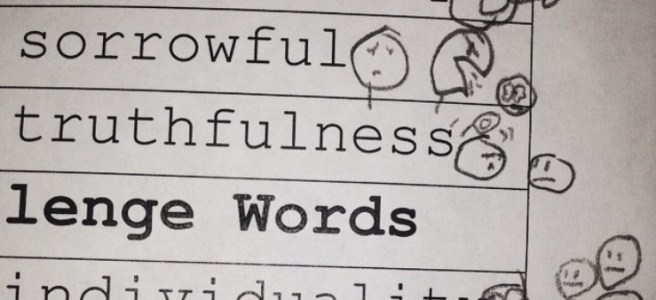
You have to be courageous, confident, and often live with regret when you are honest, because people rarely want to hear the truth. The image I’ve included in this post is a sketch from my son. In order to remember his spelling words, he sketched faces beside them expressing what he believed conveyed the word. When you look at the faces beside “truthfulness,” although one wears a halo, they both look anxious. Telling the truth is hard; hearing the truth is hard.

My father once told me, “You couldn’t be more like me if you tried.” Although I was sincerely flattered to hear that, I knew it meant I am also brutally honest, have a terrible poker face, and tend to alienate people because I struggle with being dishonest even in polite conversation when sometimes you should be. This is not to say I have never told a lie. I have. And some have caused irreparable damage in my life. It’s just that lying to people causes me great internal struggle, reddens my face, and fills me with crippling guilt.

Similar to most people, it’s also not easy for me to hear the truth. When people have told me I’m too analytical, sensitive, dramatic, or that I remember more negative details than positive, I stiffen with defensiveness. All of the preceding statements are true. I am also self-deprecating, affectionate, and loyal. The older I get the kinder I am to myself (and others), and I try to work with not against my human flaws.

One of my most irritating traits, I’m guessing because I’ve received a lot of flack for it, is my incurable need to discover the “why” behind just about everything. Why did my mother leave? Why did my stepmother beat me? Why do dishonest people seem to have more success than honest ones? Why did my brother get killed? Why did my husband die? Why do I have so much trouble sustaining a romantic relationship when others seem to just do it? Why are people mean? Why I did reject the man I believe is my true love?

On a positive note, once I process the Why in my head, through writing, art, or talking, I can usually let it go. In some cases, like with the death of my brother, I’ve had to make peace with not knowing why it happened. That has taken 30 years. I’m still struggling with the true love question. The other whys might be explained with psychology, self-help books, chats with friends, or talk therapy–of which I’m a huge advocate. But one important lesson I’ve learned is that in order to process these questions and heal, you have to be 100% truthful.

In the book, The Courage to Heal, which I highly recommend if you’ve suffered any personal trauma, the word courage is aptly used. It’s so much easier, and fun, to ignore our flawed humanness and not heal. For years, I was the party girl, loved getting drunk, being around people, being loud and obnoxious, all in an effort not to spend time alone and seek the truth within myself. I’d gone to therapy, but never engaged fully with the tenets. It took my loving someone other than myself to see how badly I needed help.

This person is still in my life, and because we’ve hurt each other, we have had to start rebuilding trust from the bottom up. Being honest takes courage, confidence, and working through regret to move forward when we hurt each other now. But, as you’ve probably heard or experienced, there is no greater reward than having an honest, open relationship with someone you love. And I want that.


Navigating Different Communication Styles

Over the past 18 months, I’ve been meeting with a behavioral therapist, as often as once a week. When I started, I had been sitting in a pit of despair after realizing too late what a special and rewarding relationship I had with my husband of nine years. I had turned 40 in 2008 and sort of lost my mind over the next two years. The collateral damage incurred by us and our sweet family post-split still nags at all of us. We are healing, albeit slowly.

Through my therapy I’ve learned that one of the issues “Eric” and I dealt with during our marriage and divorce involves our vastly different communication styles. We are similar in that we’re both passionate, quick-tempered and stubborn. However, I am a moving-toward quick-processing extrovert (MTQPE), and he is a moving-away slow-processing introvert (MASPI). Night and day. Black and white. Scorpio and Taurus.

Defining the styles. Moving-toward means I’m the woman who talks to strangers and wants to save the world even when it’s inconvenient for me. Moving-away Eric hangs in the background and observes the scene before he makes a move. The night we met, I walked up to his adorable self at Little Harry’s Airport Bar in Lewiston, Idaho, and said, “Hi. I’m Cindy. Wanna buy me a drink?”

Eric likes to listen and assess, and he’s good at both. I like to chat, on and on, and recharge when I’m around people. Eric recharges by spending time alone. Quick-processor me can call him on a Monday at 8:00 a.m. and say, “Wanna take the kids to the theme park this Friday? Do ya? Huh? I’ll drive. I’ll buy the tickets. What do you think? Huh?” Slow-processor Eric would probably take a minute to answer: “I don’t know. Let me check and get back to you.”

When you’re in love with someone, these differences seem minor. But after years of mistaken assumptions and misinterpreted silence, they can wear on a person, even destroy an unexamined relationship. And then, when you’re in the middle of a breakup, these differences cause real arguments.

Being aware and strategic. Eric lives in his head much of the time (he’s amazing at self-reflection) but I process my life out loud, through talking. If you are a MASPI, like Eric, I would drive you bonkers. If he has anything on his plate, work issues, personal stuff, bills, he would prefer to slide the theme park to the bottom of the stack until he was ready to tackle it simply to avoid feeling overwhelmed. Meanwhile, I’m doing aerobics, playing paddle ball with one hand and whirling a figdget spinner in the other.

Eric and I have been divorced six long years. In the past ten months, we have been scheduling monthly “conversations” where we talk about the kids, our lives, and manage our different communication styles. One of the most important things I’ve learned relies on the premise that my style is no better than his style. They are simply different. In this post-therapy stage we’re in, Eric and I work hard to treat each other with dignity, and examine and respect the styles.

Being versus foreseeing. Being an MTQPE, I would love to know exactly when I’m going to see and talk to Eric. I recharge when I’m around him. But, when a moving-toward person moves too quickly or too often, a moving-away person tends to get his energy zapped and needs more space. That is a style, not necessarily a strategy.

Eric is content just being. He doesn’t need to plan every movement of his day or his life. I, on the other hand, want to see into my future. When will we meet again? When we will talk again? Forward, forward, forward. One of the things my therapist helps with is my feeling comfortable in the not knowing. (Eric tries to meet me halfway by communicating more.)

We are less than a year into this process of trying to communicate effectively. We stumble. We piss each other off. We spend hours laughing. It’s an unpredictable way of living. But, I am slowly gaining comfort and working to make him feel safe in my presence. The closer we can come to meeting in the middle, the better off we’ll be.