A Glimpse Into Wilson’s Disease

The Assumption

My husband Harly thought he had the flu,
felt lethargic and never wanted to eat.
I just thought he was lazy. After hauling
bags of grass seed all day at the local plant,
he’d flop down on our couch, slather Vicks
on his chest, cuddle with our baby girl
and watch Barney. He stayed up late into
the night playing TechnoBowl, chest pains,
tingling in his joints, then fell asleep, TV
blaring, lamps aglow. He never left the house
except to work, and when he pressed his calves,
he left fingerprints. After his stools lost color,
we saw doctors who dosed him, told him eat less,
walk more. It was a nurse who noticed
the golden hue of his eyes and skin, insisted
on a blood test that showed a liver gone bad.

I drove us back to our modest home in our town
of a thousand. Harly sat in the passenger seat,
sniffing—a twenty-seven-year-old man
who would need a specialist, tests, a transplant.
But right then, all he needed was to hear
the radio play Tom Petty, to rest his head
on my chest. He smelled of sweat and soap.
I’d never seen him cry in the time we’d been
together, but over the next six months,
as he watched his baby girl scream through
her own blood tests, his brother lose his life
to the same disease, his own body wither
from broad-chested and strong to brittle
and thin, I’d wipe them away, one by one,
as they blended into his yellowed cheeks.

What Not to Say After a Funeral

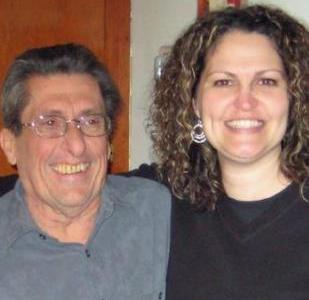
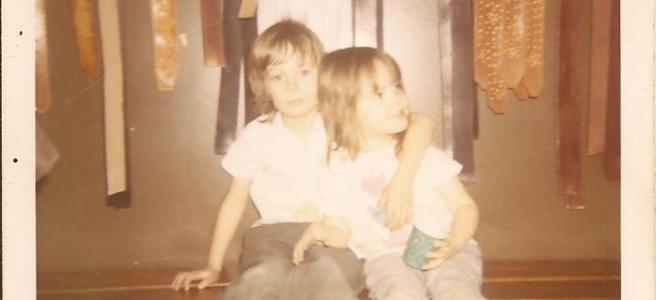
Brother and sister

When I was a senior in high school, I took a class called On Death and Dying. During one particular class period, the teacher, Mr. Jones, asked, “Who in here has had someone close to them die?” A few people raised their hands. I was
not one of them. At 17, I still had both parents, grandparents, siblings, and had never lost anyone. Within a year, all that would change.

In May 1987, my 21 year old brother Tony was killed in a motorcycle accident. I was 18. Suddenly, all that abstract information about Elisabeth Kubler-Ross and the Five Stages of Grief came flooding back. Mr. Jones showed up at Tony’s funeral, and I remember thanking him for the class. I told him I would be a wreck (as if I weren’t) without having all that knowledge.

The aftermath of Tony’s death was far more painful. My father leaned on his wife for strength, and my younger brother was 11. So, I felt as though I had no one to turn to who understood the depth of my pain at losing my beloved brother. Tony would have been the person I leaned on had our father or grandfather or younger brother passed. I’d heard the word “Sorry” from hundreds of people, hundreds of times, so it became empty. And I became angry that everyone else was able to return to their everyday lives.

Over the next several years, when I talked about Tony’s death to people who had never experienced the loss of a loved one, I was stunned by some of the responses I heard. “You must be strong. If my sibling died, I’d kill myself,” or “Everyone dies. You need to get over it,” or “I know just how you feel. I once lost a cat.” I listened to these comments in silence, judging these ninnies in my head.

Exactly ten years after my brother was killed, I lost my young husband to a genetic liver disorder. I wrote “Harly’s” eulogy, and invited two of his cousins and one of his best friends to speak at the funeral. I played a couple of his favorite songs from the 80s. During the eulogy, I tried hard to keep from crying as I relayed the last six months of his life in his struggle against Wilson’s Disease. I did the best send off I could to honor my 27 year old husband. Tony’s death a decade earlier probably helped me emotionally when dealing with Harly’s death and the grieving that followed.

Once again, however, I was ill-prepared for the comments that would come after the funeral. “Wow. My husband and I have had our problems. But I’m so lucky to have him,” and “Your eulogy sure was negative,” and “Why did you have an open casket. We didn’t need to see him,” and “You must be strong. If I lost my husband, I would kill myself.”

Now, in the defense of these folks, no one knows what to say if they’ve never been through this, right? So, looking back, and it’s been 27 and 17 years, respectively, I can say, no one meant to come right out and pour Tabasco sauce into my open sore. At the same, I like to hold on to a statement said to me as I stood outside the funeral home talking to friends. Reed Herres, a long time friend of Harly’s, walked over to me, and said, “I don’t know what to say. So I’m not going to say anything.” And then he hugged me.

You might think because I’ve been through the death of a sibling, and a husband, and now my father, that when I attend a funeral I know just what to say to the grieving. Nope. I find myself at a loss for words just like so many others. Every person grieves differently, and every loss is a new experience. Depending on how well I know the person, I tend to follow Reed’s example and offer a hug. Then I lean forward and ask, “Is there anything I can do for you?”
My Kid’s Smarter Than Your Kid–Pondering Competition

My daughter Jessica was still crawling at 15 months. Because other toddlers I knew had already started taking their wobbly first steps, I called the pediatrician. He said, “If she doesn’t start walking by next month, bring her in. We’ll put braces on her legs.” Jessica started walking that week. And because I now know that she gets embarrassed over everything, I’m sure Jessica overheard the doctor and was afraid of looking like Forrest Gump.

In kindergarten, Jessica tested into a program called Enrichment–what some schools call “Gifted and Talented,” because she knew how to read. Jessica was not the type of student to push herself when she was bored, and I suspected this program would encourage that. I was feeling pretty good about myself and Jessica’s father–a meteorologist for the U.S. navy–that we had drawn the long straw. We had a smart kid.

When Jessica entered 4th grade, it was the first time I interacted with the parents of other “smart kids.” At the time, I was a 32-year-old grad student in English at the university in Bellingham, Washington. It was five p.m., and when I walked into the elementary school library for the parents’ meeting, Jessica holding one hand and my five-year-old daughter, Josie, the other, I felt like a kid. No other parents had brought their kids, and they all had gray hair and wrinkles. They were dressed in blazers and slacks. I was a grad student in a sweater and ripped jeans.

The atmosphere in the library bugged me–the sense of smugness in the air. Every couple sat with their noses held high, discussing the curriculum, talking about art programs their kids were involved in, or awards they’d received. They talked about math olympics, writing contests, music lessons, physics and future problem solvers of America. I kept quiet, thinking about how grateful I was simply to have Jessica in the program. These parents seemed to believe that their smart kids were a reflection of their own intelligence.

One of the reasons I was so pleased to see Jessica succeed academically was because I hadn’t. I wasn’t dumb, but education wasn’t valued in my childhood household. My father owned a shoe repair shop. He was funny, friendly and blessed with common sense. When I was in high school, my father told me: “Just get Cs, and I’ll be happy.” So I learned that I had to care about doing well for myself. I only put forth effort in the classes I liked: art, theatre and English. And I didn’t start college until I was 24.

Jessica quit the Gifted and Talented program in 7th grade–when it was no longer mandatory. I begged her to stay in. “I don’t want people to think I’m a geek,” she said. She wouldn’t believe me when I told her: “You can’t control what people think.” Within a year, her grades tanked. Boys and parties became much more important than solving America’s problems, writing poetry or competing in math. By this time, I had finished my graduate degree and was working as a writer. When Jessica failed freshman English, I figured she was rebelling against me.

My smart kid graduated from high school with a 1.67 GPA. Her father gave her his G.I. bill money so she could attend community college. She loved it, but failed out after a bad breakup during her third quarter. Jessica took a year off and is back in college, working part time as a waitress. Like a lot of us, she regrets not trying harder when she had the chance. She even says, “Mom, you should have pushed me harder. But when I was in those classes, I felt like the dumbest kid there.”

As a parent, you never know how well you are doing. At best, raising kids ebbs and flows as continuously as the tide. Jessica crawled for 15 months and I never worried until I noticed other kids “beating” her. Competition makes us crazy. A poetry teacher told me once: “Comparing yourself to others is deadly.” I say it’s also inevitable. Perhaps it keeps us ambitious. Aware. After all, competition made me call the doctor.

Ever wonder how I got my title The Cobbler’s Daughter?

The answer’s more involved than my father working as a shoe repair man. When I watched my father stand over the last, his face less than a foot from his work, he concentrated deeply. The shoes he fixed were perfect. He sewed leather with thick thread, pounded soles, buffed and polished.

This perfectionism carried over to me. It’s what got me in trouble in preschool when a kid stuck a felt eyebrow upside on the face we were making in class and I yelled, “He did it wrong.” The teacher put a finger to her lips and frowned in my direction. I was four–already an editor. As I came of age, I loved the exactitude of words spelled correctly, coloring inside the lines and memorizing nursery rhymes.

He toiled Monday through Saturday, 9 to 9 for the first several years he owned his business. And when I was five, I got my first job peeling boiled eggs at the Gondola Restaurant for three dollars a day. I am a cobbler’s daughter for my work ethic. I’ve been a door-to-door greeting card saleswoman, papergirl, babysitter, fast-food employee, lifeguard, diet aide, retail sales clerk, navy data technician, video store clerk, teacher, tech writer, the list goes on.

My father taught me “Work will see you through.” For this gift, I am most grateful.

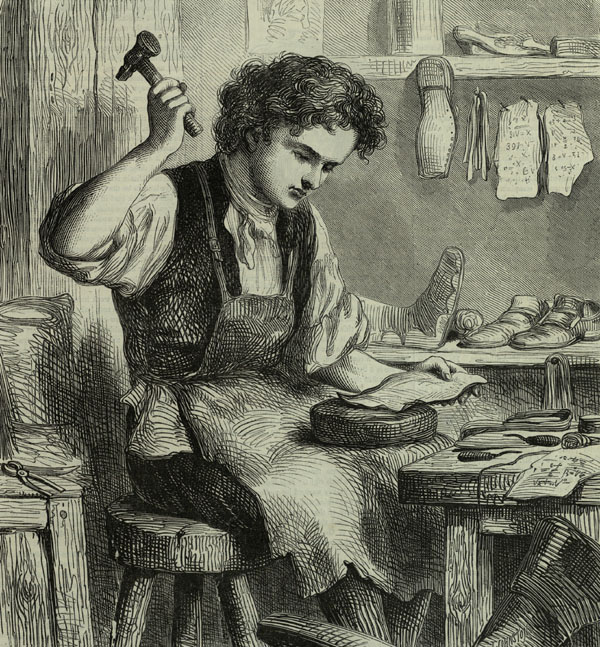
How a small boy became a great man, illustration

How Young Do Kids Learn Empathy?

Salt dough

My daddy died, says the four-year-old girl—
squishing and smashing lilac salt dough
into sea stars and snowmen at the daycare
craft table. She licks her fingers. Don’t eat the dough,
the caregiver says. A boy in a blue and green
striped shirt stacks blocks. The girl eyes
other kids’ paintings of mommies, daddies,
kids and dogs. My daddy died, she repeats,
looking around. The boy turns his stringy-haired
head her way, eyes her from her wavy bangs
to her purple fingers. I don’t have a dad, he offers.
Never met him. The caregiver tilts her head,
half-smiles. The boy rests the last block on the stack,
watches the tower weave before it falls to the table
with a boom and clack. He runs to the boy’s room.

The girl lifts a rounded mound of salt dough,
makes sure no one is watching, takes a bite.

Corn is a four letter word.

Three years ago, I almost lost my son Vinny to his severe food allergy to tree nuts. He secretly ate a piece of toffee and lied about it. While his father and I sat in the E/R crying and watching Vinny sleep off his Benadryl/Epi-pen-induced coma, the doctor came out and said, “That boy needs to be under the care of an allergist.” Within the week, Vinny had an appointment.

We already knew Vinny was allergic to peanuts and tree nuts from an earlier blood test. But now we were requesting a food panel. They would only test for a couple foods, because of his potential for an anaphylaxic reaction. I agreed to be tested, too, to offer moral support. Turned out Vinny and I are both allergic to cats, dust, dust mites, and all the grasses, weeds, and trees that grow in Idaho. He’s also allergic to dairy and corn. I’m allergic to chicken, barley, malt, coconut, and corn.

At the time of the allergy test, I wore a size 10. I was still drinking beer, eating bread, fried foods, including chicken, you name it. I was running three miles a day several times a week and lifting weights. I looked pretty good and weighed about 160 for my five-foot-six frame. The allergist recommended a full elimination diet.

Later, I discovered that if I ate any type of food with corn in it, i.e., restaurant french fries (deep fried in vegetable oil that had corn oil) or enchiladas with corn starch, Heinz ketchup, gravy, within two days, tiny blisters formed on my fingers that opened up into full-blown eczema. And since I’ve taken corn out of my diet, I’m incredibly sensitive to its effects.

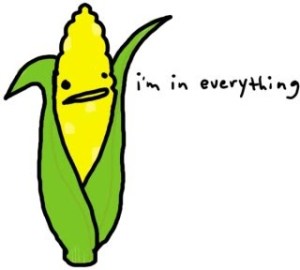
Corn is everywhere: dextrose, fructose, modified food starch, Xanthan gum, vegetable oil. I can’t eat at any fast food restaurants or fried foods at sit down places.imin

Vinny’s ten. He eats popcorn, which makes his skin itchy. He says he doesn’t care. The allergy will become worse with age. He cannot eat dairy. It gives him horrible flatulence and the runs. And as one teacher described his behavior after he dairy: he wilts like a flower.

The benefits of my food allergies are that I have been turned on to clean eating, and my body has shrunk four pants sizes. I’ve lost 30 pounds because of healthy eating! I have to watch every bite I put into my mouth, not because I want to lose weight, but because these foods I’m allergic to quite literally poison my system. The effects of chicken on me aren’t even worth discussion. Once you stop eating poison, your body loses inflammation. It’s that simple.

When I go to barbecues, restaurants and gatherings with friends, some say, “Wow. I’m lucky. I’m not allergic to anything.” I’m like, “Really? Have you ever had a food panel done? How do you know?” Plus, I didn’t ask for this. A little sensitivity goes a long way, folks.

Writing to Heal and to Feel Connected

When you’ve had experiences such as mine–emotional, physical, and sexual abuse during childhood–you can choose to ignore the pain or zap its power through the written word. Yes, it’s scary.

I write to share my experiences with others to create a sense of community. Because when I read the work of others who have had experiences similar to mine, I feel less alienated and less “freakish.” In the words of John Lennon: “It’s not just me.”

Today I learned that my best friend, a therapist, lent my poetry book Suede to a client, who was able to use my poetry as inspiration to write her own healing poems. That, my friends is what it’s all about. Let’s continue to form a community of writers, readers and healers. Let’s make each other feel more connected.

1909872_47644958186_2319_n


Live and Let Write

Recently, I was asked to respond to a blog post by a fellow blogger. A fellow writer posed the question “which courses should I take if I want to learn how to write?” I simply shared the courses I took when I was a student at Lewis-Clark State College in Lewiston, Idaho.

Not long after my post, a young man posted a response to my response that I found a bit disconcerting. He came back with something similar to don’t waste your hard earned money on a degree when you could get the same in late fees at the library. Obviously, this is not a direct quote.

Let’s forget first of all that there was a typo in the quote he did post. He meant to say “writer,” but he wrote “write,” so instantly he lost credibility with me.  It’s not that I haven’t made errors—big ones. But if you’re going to argue for or against a cause, double check your words.

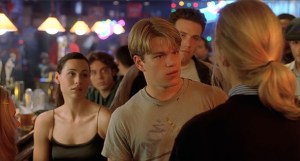
Let’s also forget that he didn’t cite where he lifted the quote from. He took it from the movie Good Will Hunting, which I love. As a matter of fact, it happens to be one of my all time favorites. I’ve seen it numerous times, and I have shown it in the classes I teach.

Good-Will-Hunting-Script

Basically, the quote is from the scene where Will takes the graduate student aside and chides him for his “overpriced degree” when all he really needs is to read a slew of books from the library. And, if the young man who responded to my post would have gotten the point of Good Will Hunting, the story, that is, it was that Will needed other people. That his reading all of those books in isolation didn’t allow him to grow.

In summation, the blog poster was either trying to be a complete smart ass or was just plain ill-informed. I am hoping for the latter.

If you want to be a writer, take any path you wish.