Smoking With My Brother

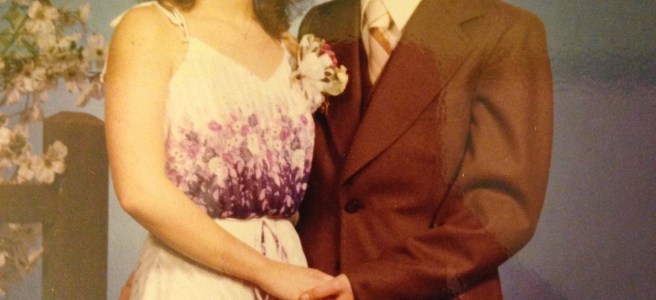
You left us at 21—brown leather jacket and
blue jeans, feathered hair parted down the middle,
freckles, the bright green eyes you got from
our mother. I never wondered if her leaving
broke you, smoking and drinking by 12,
popping pills by 13, dealing drugs in your
Windsor knot and dress pants to the stoners
at our catholic school just down the block
from home. You worshiped the Doors,
danced with the gangly arms and wild heart
of a rock star, and Dad imagined you’d run off
to join a band and never come back—like her.

After your wreck on that rainy night, we found
your box of poems, foretelling a life that would
end before you aged. “Never trust anyone over
30,” the hippies once chanted, and you would
have raised your fist right alongside them.

Dear brother, this year you would be 49, far
too old to trust—and yet, I would still follow
your hunched shoulders all the way down
to the creek slithering behind Grandma’s,
pack of lifted Winston 100s and box of matches,
I’d perch beside you on a flat rock, light
the cigs against the wind, and not yet knowing
how to inhale, but so you’d think I was as cool
as I believed you to be, hold the smoke in my mouth
as long as I could stand, the stale taste of tobacco,
cotton and paper mixing on my tongue, pretend.

What Not to Say After a Funeral

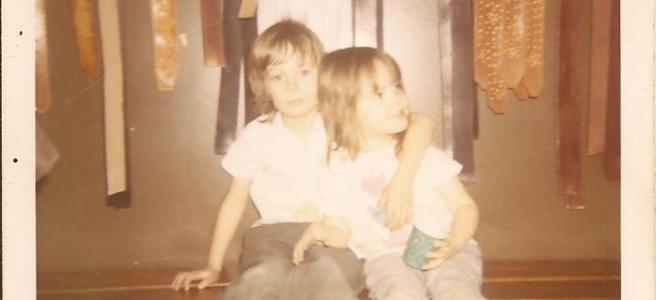
Brother and sister

When I was a senior in high school, I took a class called On Death and Dying. During one particular class period, the teacher, Mr. Jones, asked, “Who in here has had someone close to them die?” A few people raised their hands. I was
not one of them. At 17, I still had both parents, grandparents, siblings, and had never lost anyone. Within a year, all that would change.

In May 1987, my 21 year old brother Tony was killed in a motorcycle accident. I was 18. Suddenly, all that abstract information about Elisabeth Kubler-Ross and the Five Stages of Grief came flooding back. Mr. Jones showed up at Tony’s funeral, and I remember thanking him for the class. I told him I would be a wreck (as if I weren’t) without having all that knowledge.

The aftermath of Tony’s death was far more painful. My father leaned on his wife for strength, and my younger brother was 11. So, I felt as though I had no one to turn to who understood the depth of my pain at losing my beloved brother. Tony would have been the person I leaned on had our father or grandfather or younger brother passed. I’d heard the word “Sorry” from hundreds of people, hundreds of times, so it became empty. And I became angry that everyone else was able to return to their everyday lives.

Over the next several years, when I talked about Tony’s death to people who had never experienced the loss of a loved one, I was stunned by some of the responses I heard. “You must be strong. If my sibling died, I’d kill myself,” or “Everyone dies. You need to get over it,” or “I know just how you feel. I once lost a cat.” I listened to these comments in silence, judging these ninnies in my head.

Exactly ten years after my brother was killed, I lost my young husband to a genetic liver disorder. I wrote “Harly’s” eulogy, and invited two of his cousins and one of his best friends to speak at the funeral. I played a couple of his favorite songs from the 80s. During the eulogy, I tried hard to keep from crying as I relayed the last six months of his life in his struggle against Wilson’s Disease. I did the best send off I could to honor my 27 year old husband. Tony’s death a decade earlier probably helped me emotionally when dealing with Harly’s death and the grieving that followed.

Once again, however, I was ill-prepared for the comments that would come after the funeral. “Wow. My husband and I have had our problems. But I’m so lucky to have him,” and “Your eulogy sure was negative,” and “Why did you have an open casket. We didn’t need to see him,” and “You must be strong. If I lost my husband, I would kill myself.”

Now, in the defense of these folks, no one knows what to say if they’ve never been through this, right? So, looking back, and it’s been 27 and 17 years, respectively, I can say, no one meant to come right out and pour Tabasco sauce into my open sore. At the same, I like to hold on to a statement said to me as I stood outside the funeral home talking to friends. Reed Herres, a long time friend of Harly’s, walked over to me, and said, “I don’t know what to say. So I’m not going to say anything.” And then he hugged me.

You might think because I’ve been through the death of a sibling, and a husband, and now my father, that when I attend a funeral I know just what to say to the grieving. Nope. I find myself at a loss for words just like so many others. Every person grieves differently, and every loss is a new experience. Depending on how well I know the person, I tend to follow Reed’s example and offer a hug. Then I lean forward and ask, “Is there anything I can do for you?”

1973-The Year My Brother and I Ruined Christmas

Christmas Eve finally arrives. Tony is seven, and I am five. We beg my father and stepmother Vickie to let us open just one gift before going to bed, but they won’t relent. My father sits on the couch with his arm around Vickie. “The quicker you get to bed,” he says, “the quicker Santa will get here.” So we shuffle to our bedroom, my stomach tight.

I have just barely closed my eyes when Tony shakes me awake. For a moment I forget where I am, searching the blue walls for clues. I rub my eyes.

“Come on,” Tony says. “Let’s see what Santa brought.”

It’s still dark outside. I ask Tony again whether it’s really time to get up. “Yes,” he says, “Let’s go.” I hold tight to his hand as he drags me down the hall, tiptoeing past the room where my father and Vickie sleep.

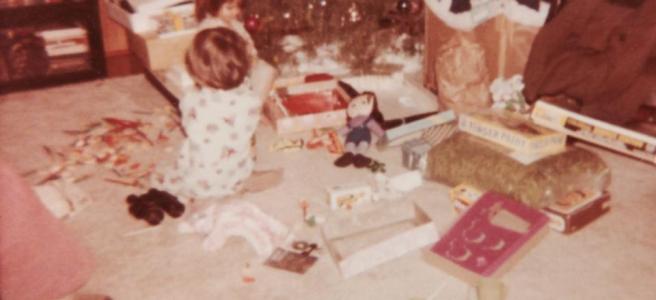
When we step inside the living room, presents—rectangles, squares, lumpy spheres—form a pile around the tree. I have never seen so many gifts in my life. Tony clicks on the light and for a few moments, I stand there, ogling the shiny foil bows, white and crimson wrapping paper, the overfilled stockings hanging from the cardboard fireplace. This is Christmas!

Tony kneels in front of the tree and starts to pick through the gifts. “This is for me!” he says, shaking the box.

“I want one!” I say, snatching the first present I see. I tear open the wrapping to find a pair of women’s bedroom slippers. I slide my small foot inside the giant slipper. “These don’t fit.” I toss the pair behind me. I open a box with a sweater that’s way too big.

“No way,” Tony says. His light brown hair sticks up in front like devil’s horns. “It’s the Evel Knievel stunt cycle!” He squeezes the box. “I got it!”

“Where’s my presents?” I huff, crossing my arms over my chest.

“Right here, dummy,” Tony says, dropping a rectangular box in my lap.

I open it to find a Tiffany Taylor doll, which looks even more beautiful than on the TV commercial. Tiffany is two feet tall and wears a glittery gold bodysuit beneath a lime green skirt that attaches at her abdomen with Velcro. Her slip-on mules match the skirt. Tiffany has blond hair parted down the middle, but when you grab the top of her head and rotate, she has brown hair and bangs.

The next gift I open is a personal grooming kit with a white plastic hairbrush, comb, and mirror made of pearly plastic. I hold the mirror in front of my face. “Yes, dah-ling,” I say. “I vill be right wid you.”

There’s a really big gift. It’s the Sunshine Family Dolls. It comes with a camper and a surrey cycle. The baby is so cute.

“What the hell are you doing?” My father booms, standing above us in nothing but tighty-whities. His hair sticks up like the bride of Frankenstein. “Get your asses back in bed.”

Tony and I sprint past our father, guarding our hind-ends from spankings. My father slips into his bedroom with Vickie and slams the door. I throw myself on the bed and bury my head in the pillow. Tony sits on his bed.

“We ruined Christmas,” I wail.

Tony lays back on the bed and folds his hands behind his head. I pull the covers over me and hide. We both fall asleep.

We are lying still when Vickie walks into our bedroom. She is wearing her ever-present light blue bathrobe. Her hair is messy and she wears no makeup. “Your father and I are disappointed because we wanted to watch you open your presents,” she says. “And some of those weren’t even for you.”

I start crying again. Tony sits up.

“Now, go wash up,” she says, “Your dad and I will meet you in the kitchen.”

Usually, Vickie flew off the handle over something as small as spilled milk. But, neither she nor my father scolded us that day. We played with our new toys, had dinner. Even today, I’m surprised they were so kind about the whole thing. My kids never tried anything so subversive with me, and I wonder how I would have handled it. . . I know I would have made them re-wrap the presents not for them.