Do as I Say and Not as I Do

Years ago, I promised myself that when I became a parent, I would never use the phrase “Do as I say and not as I do.” It’s hard to believe I actually heard this phrase from my stepmother all the time when I was a kid. My parents smoked cigarettes and pot, and got drunk as all get out, then told my brother and me not to smoke or drink. My stepmother used the word “fuck” as a convenient adjective, but my brothers and I were scolded for saying “freaking” or “sucks.”

While I never used the phrase with my kids, I know I’ve implied it. Nothing turns a person into a hyprocrite faster than being the parent of a tween. “Mom? We learned about drugs in school. Have you ever done drugs?” “Mom? Is Dad the only man you’ve had sex with?” “Mom? How old were you when you first drank alcohol?” You see my point. Unless you plan to divulge every naughty thing you’ve ever done in your entire life to your maleable child, you will be forced into being a hyprocrite. At least my heart is in the right place.

When I reflect on the barrage of mistakes I’ve made throughout my life, things like spreading gossip to falling for a guy who said he loved me and didn’t to dumping a guy who really did love me, telling and/or believing lies, and getting married when I should have run for the exit, I hope to protect my kids and loved ones from making the same mistakes, suffering the same hurts, and enduring the same humiliations. Of course, that’s not how it works. Everyone needs to learn for themselves.

For instance, my first serious boyfriend, “Randy,” and I started dating three weeks before my older brother Tony was killed in a motorcycle accident. I was 18, a grieving mess in need of love, and fresh prey for the malignant narcissist that Randy was. He charmed his way right into my life: I moved him into my apartment, never charged him rent, and never had a job (except the occasional drug deal). Randy cheated on me incessantly, stole money from me, and somehow I believed I loved him.

After a year of catching Randy in lies, being evicted from numerous apartments because of fights, and seeing him come home with hickies from other women, I finally dumped him. He started bawling and slapped me across the face. “This is why I’m leaving,” I said. And while I thought I was free, over the next several months before I left my hometown for the U.S. Navy, Randy slithered in and out of my life. Today, friends say he’s an incurable heroin addict still living in our hometown.

What surprises me is that during that 18 months, my father never said a negative word about Randy to me. How difficult it must have been for him to see his only daughter crying hysterically when Randy stood me up, the crappy apartment I shared with Randy, and the long-haired bum in tattered jeans and concert T-shirts holding his daughter’s hand at family functions. Although my father knew this relationship was a disaster that would blow up in my face, he never said a word.

If you’ve never had a Randy in your life, consider yourself lucky and unlucky. Lucky because you haven’t suffered the hell of loving a malignant narcissist. Unlucky because you’re still innocent enough not to recognize a malignant narcissist when one oozes into your life. You may fall head over heels in love with him or her and be blindsided when their house of cards drops on your head.

My friends and family members who have been burned by a malignant narcissist and I have so much to talk about when we get together: the endless love letters at the beginning of the relationship, the speedy pleas for commitment, the soul-mate and “us against the world” bullshit, and of course, the frequent hot sex. (Distraction!) If you’re at a vulnerable point in your life, it’s very easy to get seduced by a Cheshire Cat–they are charming, good looking, and unbelievably skilled at lying. The worst part is NO ONE can convince you this person is a lying, cheating, despicable waste of your time.

Once the narc has earned your trust and loyalty, just like a cat with a dead mouse, they toss you aside. But you have already fallen in love. So, now you’re sunk. They start criticizing you, are probably already cheating, find excuses to see you less, and when you share your feelings, they call you needy, weak, and crazy.

All I can say is trust your gut! If something smells fishy, gives you a stirring in the belly, or just feels wrong, get out. Better to miss out on a lying, cheating, asshole who may be fun to hang with than be dumped by a lying, cheating, asshole who will never leave you alone. And the narcs favorite line is … refer to the title.
It’s All My Fault

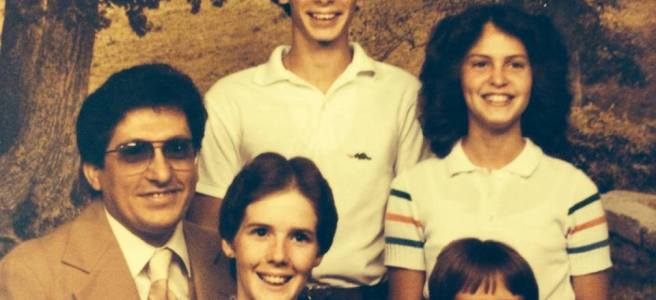
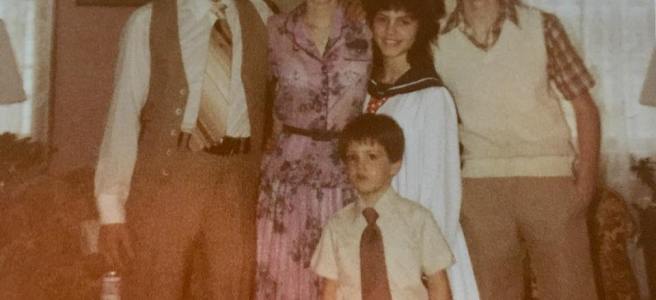
I’ve been thinking a lot about responsibility over the past couple of days. For as long as I can remember, I have felt “responsible” for other people’s feelings — their happiness, anger, sadness, hunger, well-being, etc., etc. Some of it, I believe, comes from being an older sibling. I was seven when my brother Jack was born, and from the moment I saw his pursed lips and downy hair, inhaled the baby scent from the top of his head, I wanted to protect him. It was both understood and stated, with my father’s tireless refrain: “Watch your brother. Watch your brother. Watch your brother.” I adored Jack, and enjoyed feeding him, changing his diapers, and cuddling with him on the couch.

The responsibility thing really hit home during Christmas 1977. I brought home an ornament I’d made at school: green construction paper, red yarn, and silver glitter. Although I don’t remember, I must have left it on the dining room table where my stepmother was displaying all of her Princess House crystal. I was at school when Jack pulled on the table cloth and hundreds of dollars of crystal crashed to the floor. When I arrived home that evening, my stepmother screamed and screamed. Since Jack was only a toddler, and was trying to get my ornament, the broken crystal was all my fault.

Years later, when I started dating, I took responsibility for the feelings of my boyfriends, and anyone else who came along. If X had a bad day, it was up to me to cook him a nice meal and let him relax so he cheered up. If X wanted to go to dinner, I chose the restaurant, and if he disliked the meal it was because I had made a bad choice. If X’s family didn’t like me, it was because I was too sensitive and analytical, so I tried really hard to be amazing and wonderful.

Most recently, I’ve been reflecting on how I felt responsible for my father’s happiness. His wife was an incurable cheater, and I never told him, until 1988, when he received an anonymous letter saying “Your wife is sleeping with my brother. He’s married and has five kids.” My father confronted my stepmother, and of course, she said it wasn’t true. So, he hid a tape recorder in his bedroom. Confronted with the evidence, she said, “How dare you spy on me.”

My stepmother was a special kind of crazy, both unpredictable and prone to violent outbursts, the kind of crazy I couldn’t manage as a 20 year old. But, I figured since my father had confided in me, and was planning to divorce her, I should take him out for a drink and spill my guts. We went to the No. 5 in Binghamton, New York, and drank late into the evening. I told him everything I knew about her cheating, starting from when I was four until the present day. My father showed no emotion. The following day, he filed divorce papers and sent them to his mother in law’s house where his wife was staying.

A couple of weeks later, my father invited me to dinner at his house with Jack. On the drive over, he said, “I’m gonna take her back.” I started bawling. All those stories! All of her lies! “How could you?” I asked. My father said when he brought over the papers, she fell to the floor and started kissing his feet. She promised over and over to stay faithful. “I don’t approve,” I said. “But you’re a grown man.” He smiled, and answered, “You’re absolutely right. You’re so protective. Just like grandpa.” Damn straight.

There have a been a couple more times in my adult life where I have had the opportunity to let a person I care about know they were being cheated on. Both times, after telling, it blew up in my face. So, if you’re keeping track, that’s three strikes. I’m out.

It really sucks to see someone you love getting hurt by someone else simply because they are a good liar. However, if you out a cheater, that falls right in line with shooting the messenger. You’re going to get hurt unless the person you tell has an enormous amount of self awareness, and believes you, not the cheater. At the same time, if you’re like me and have a visceral reaction to seeing your loved ones getting screwed over, perhaps you can explore those feelings in a blog post.

P.S. My father and his wife renewed their wedding vows in 1988, moved to Florida the following year, and bought a business. Ten years later, he filed for divorce and they went through an acrimonious process. My father moved back to Binghamton.

Secrets Cause Cancer

When I was 14, I told my younger brother that his mother was not my mother, and that we were half-siblings (we never have and still don’t use that term.) Within a day, I stood before my father, staring at my feet, listening to his diatribe about my stupid decision. He punctuated the lecture with a hand in the air, and said, “You gotta b–iiiii–g mouth!”

Even as I write these words, I’m not entirely sure why I told my brother the truth, and I still feel pangs of regret. However, if we look at the overall picture, how long would it have been before he figured the truth out himself? Our father was born in 1946. My stepmother was born in 1957. My older brother Tony was born in 1966. I was born in 1968. My stepmother moved in with my father, my older brother, and me in 1972. She was a 16-year-old sophomore at Binghamton Central High. And then, my younger brother was born in 1975.

The weird thing about getting yelled at for telling the truth is that my father detested being lied to. If he caught my older brother or me lying to him, the punishment was immediate and severe–my father had us open our hands, and he slapped them with his hand or a leather belt. In today’s “never harm a child” society, I realize this makes my father look bad. He hated lying.

There’s an episode of That 70’s Show when Red asks Eric to keep something to himself. Kitty, with her stiffly sprayed hair and infectious giggle, says, “Secrets cause cancer.” 276968f5a3b460c7c52492fbc73ad0d0--best-mom-kittyI believe wholeheartedly in this statement. My daughters, 26 and 22, and I, often recite this quote. And now, my 13-year-old son has come on board. One thing I love about my relationship with my kids is that we have very few secrets. There’s yelling and tears, and there’s hugging and laughs. So many laughs.
I have been criticized by people who practice more discretion with their children and families. My boundaries with my kids are as flimsy as boiled lasagna. I’m okay with that. And, I have a circle of true friends, a group whom I refer to as the “truth tellers” I can call on. There are too many to mention here, however, when I want the truth, I ask Andrea, Sandy, Aimee, Stacy, my daughters, and a few more. Someone once said, “Enemies stab you in the back. Friends stab you in the front.” I’m okay with that too.

Before I close, I have to give props to my father because he was the first person to insist I tell the truth. And, to be honest (hah!) he was one of the most honest people I knew. His honesty was hardly tactful, and he pissed off a lot of people. Then again, so have I. Not everyone likes to hear the truth. Phoebe from Friends once said, People will believe anything as long as it’s complimentary. I believe that is also true.


Writing About People Who Hurt Us

In 1997, I was a junior in Humanities at Lewis-Clark State College in Lewiston, Idaho. The journalism program was defunct, and since I had just become a 27-year-old widow with two young daughters, I switched to creative writing and enrolled in my first creative nonfiction class. I just wanted to learn how to write.

I wrote my first nonfiction piece when I was about five. It was a typed paragraph, and the paper I used ended up with a small coffee stain in the right corner. The text read something like, “I asked my father for money, but because we don’t have a lot, he said no. But at least I have a new mother, and I love her!!!!!” My father found and folded the letter, and hid it in his safe for years. In 1989, when I was in the navy, he sent me the letter with a sticky note that said, “I hope you still feel the same.”

At age 20, I did not feel the same. As a matter for fact, after my beloved older brother Tony was killed in a motorcycle accident in 1987, my father turned to his wife not me, to grieve. I blamed his wife for Tony’s death. She had been an abusive monster when we were growing up. My brother turned to drinking and drugs, I turned to men. The night my brother died, my grief trickled out into absolute hatred for my stepmother.

I mention the letter because it shows how long I’ve been in love with writing “the truth.” As I came of age, even when I wrote fiction, I used the first person “I” and described events from my actual life. Write what you know they say. As a teenager, I knew blackheads, bullying, and boys. If my stepmother had ever caught me writing negative things about her, she would have shown them to my father and I would have been punished. I was the “big mouth” who complained all the time.

When I was 13, a woman I babysat for gave me the memoir Mommie Dearest by Christina Crawford, actress Joan Crawford’s adopted daughter. My life was never the same. Mommie Dearest is an expose on child abuse. Christina’s biological mother had given her up (just as mine did) and she was being beaten, ridiculed, and shamed by her “new” mother. I had no idea that other kids suffered abuse. No one at school EVER talked about it, and when I told Tony our stepmother was mean,” he said, “Shut up. Dad doesn’t need to hear that shit.”

By the time I was in college, and had gone on to graduate school, writing my “truth” left some of my colleagues unsettled. “How can you write such nasty things about your family?” they asked. I wrote the truth, nasty or not. And since my father had divorced my stepmother in 1998 and she lived 3000 miles away, I felt somewhat safe. Writing about people who hurt us is no new debate. If you’ve read This Boy’s Life, The Liar’s Club, Hungry for the World, or Mommie Dearest, imagine the criticism those authors faced.

If anyone cares to know, writing nonfiction for me is telling the truth of my experience to the best of my memory. My father once paid me an enormous compliment after reading my work, and I keep that in mind when I write. He said, “I remember it differently, but those are your memories.” For a man with a high school education and shoe-repair man’s apprenticeship, I thought he sounded damned professorial.

And speaking of professors, my first writing teacher, who is also a dear friend and mentor, once said, “No one is all evil or all good. You have to show them as a rounded human being.” Believe it or not, rounding out my stepmother is not that difficult. Writing about my brother Tony, however, whom I worshipped until the day he died, that’s a whole other story. I was his patsy, his sidekick, Laurel to his Hardy. One day, I may sit down and write the truth of our story. But I’m still working on it —


Unlucky in Love

My father was not the best at picking women. My biological mother who was “the most beautiful woman he had ever seen” became pregnant several months into their dating. They married, had my older brother, and fought all the time. I’ve heard both sides of the story and my interpretation is this: My father was a good-time Charlie, and my mother was a feminist. He liked the Doors; she liked the Beatles. Neither was flexible. She became pregnant with me to keep my father at home. When that didn’t work, she had an affair. He kicked her out of our house and our lives. (I didn’t meet her until I was 24, a story for another time.)

The woman my father should have married, a lovely artist named Angela, was brushed aside after my father met the woman who would become my stepmother for two decades. She was a bleach-blond hourglass and 10 years his junior. She quit high school, moved in and they got married. She cheated on my father during the first year of marriage, and though he stayed married to her, he later told me “I never forgave her.”

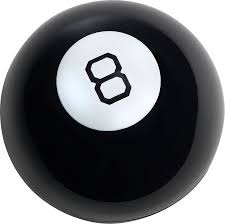
By age nine, I loathed my stepmother. That was the year I came to new awareness. She had borrowed five dollars from me and promised to pay it back. Days later, when we were at the store and I wanted to buy a toy, I asked for my money back. She said, “I took you to McDonald’s today. So, I figure I paid you back.” I stared at her in disbelief. What? Food is not cash. I want my goddamned money to buy a Magic Eight Ball.

Over the next 20 years, she cheated more, beat my brothers and me, called us names, picked my father’s pockets, and flew into rages for little more than a drop of food on her “nice clean floor.” And then, sometimes, during movies like Sound of Music, Oliver, and Terms of Endearment, she would sit on the couch, and weep like a little girl. She was a puzzle. In 1998, my father divorced my stepmother and when he called to tell me, I danced through my kitchen singing, “Happy days are here again.”

My father, bless his soul, had what one of his brother’s called, “Broken wing syndrome.” He liked to save the damsels in distress. Angela didn’t need saving. I am guessing my mother and stepmother did. Although you can see it as an altruistic method of operation, if you’ve ever tried to save someone, you know it just doesn’t work. If you’re lucky enough to find one person to love who supports you and you support them, hang on tight. When I shake the Magic Eight Ball and ask, “Will I find my prince?” It says, Ask again later.


In Defense of Rudolph

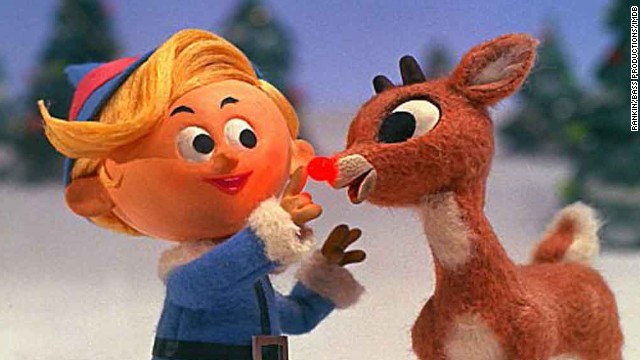
141204135426-01-holiday-tv-and-movies-story-topRecently I heard about the kerfuffle regarding Rudolph the Red-Nosed Reindeer, the stop motion animation movie from 1964. In case you’re unaware, the movie has been criticized very recently for being pro-bully. (And just to be clear, this movie came out a few years before I was born, and I’m here to tell you, it’s been critiqued for decades).

My kids grew up watching this movie, just as I did with my parents, and it has been a source of laughter around the dinner table and a conversation starter. We love the scene, for example, when the elves call “lunch break” and Hermey’s angry boss looks at him and says, “Not for you!”

Is there yelling and teasing in the movie? Yes. My kids and I find humor in the erratic behavior. Not because we are cold-blooded or evil, but because we can relate to Rudolph and Hermey. It isn’t just bullies who tease people who are “different.” In his awesome book Behave, Robert Sapolsky tells us it’s an innate human quality to malign difference, and we have to learn not do it.  It’s also a innate animal behavior (which, if I am correct, humans are animals.) Think here: chickens pecking each other.

One aspect of meanness no one mentioned is when Hermey and Rudolph ask to stay at the Island of Misfit Toys and the lion says “No. But you can do something for me.” It is so outrageously rude that my kids and I have to laugh, whether out of sheer disbelief of discomfort. How dare he deny them a place to stay and then ask for a favor.

Frankly, I have bullied and I have been bullied. I am not proud to admit bullying a girl from Lebanon in third grade. Two years later I received my comeuppance from a boy I loved who called me Ugly, Monkey Face, and Grape Ape from fifth grade to twelfth. Also, very recently I’ve been ghosted, snubbed, and triangulated by a couple of bullies.

I am not pro-bully. I am pro “let’s talk about the bullying in this movie.” Can you believe Santa was so mean to Donner and Rudolph? Can you believe the whole town shunned Rudolph until he became useful? Can you believe characters in the movie apologized to Hermey and Rudolph for being mean to them?

Bullies are never going away. Look at our President! And, if you don’t believe that, I’ll show you reindeer who can fly. I don’t have a solid answer for how to deal with a bully, because they are all different. But the ones I am dealing with now — I avoid them like last year’s fruitcake.

The Grief that Keeps on Giving

Stop me if you’ve heard this. Ten years ago, I was a happily married woman with three kids. On my 40th birthday, I looked out of the picture window of my living room and thought, “I’ve never been so happy.” My husband was an introvert, and I’m an extrovert, and we complemented each other just about perfectly. We really dug each other physically, spiritually, and intellectually. We’d been together 11 years.

Over the next several months, while my husband was earning his graduate degree, I felt overwhelmed with work and the kids, and I perceived my husband’s turning inward as turning away. I also thought he loved the one child we had together more than he loved me. For whatever reason, I was afraid to confront him with this information and figured things would simply work out as they always had before.

A guy at work with whom I’d been collaborating closely started inviting me to coffee, talking about his miserable marriage, and started flirting with me via text message. I was so in love with my husband, I didn’t think twice about any of this until it was too late. The guy chased me until I relented. We had a  three week affair and then he dumped me. To say I was devastated barely covers it–for the next several months, I hid in my room, drank alone, and dreaded seeing my husband’s family.

When I finally came clean about the affair, my husband was sad. He had to see the guy at work. My husband and I went to marriage counseling. We took weekend trips to try and reconnect. But because the “guy” was still around, it became too much for my husband. He put a GPS tracker on my phone, looked up the number of text messages through ATT, and insisted I quit my job. I put up with all of this until he turned violent. I had to kick him out of the house. He filed for divorce almost immediately.

My soon to be ex husband and I kept a cordial coparenting relationship for the kids. We sat together at Christmas concerts, sporting events, and graduations. He never really forgave me for the affair, but at least we could be in the same room. Then, in November 2016, five years after our divorce was final, my ex husband and I started hanging out together as friends. He said, “I’d like to rebuild the deep friendship we had when we were married.” We had monthly conversations, went out for beers, watched TV, and hung out with our son.

From February 2017 to July 2017, my ex husband and I casually dated. He kept saying he didn’t want a commitment with anyone, and we would see where this would go. I thought it was the least I could do since he had convinced me I single handedly ruined our marriage. Aug 12, 2017. My ex husband went to his high school reunion. The next afternoon, he shared funny stories with me.

He had been becoming more distant since July, and I figured he was still gun shy. We still went on a few dates, however, he made no moves beyond a platonic relationship. One time, he even asked me for recommendations on bed sheets. Sep 22, I told my ex I wanted to spend more time with him. He said, “I reconnected with someone at the reunion, and we’ve been seeing each other.” I said, “When you said you didn’t want a commitment, you just meant with me.”

Do you think the woman was unfettered? Nothing like me? A fresh start for my ex hubby? Think again. “Jill” was in the midst of an acrimonious divorce, had three kids, and had been dumped by her husband for …wait for it… having a 15 month affair with a man who lived in Europe, several fake FB accounts, drunken violence, and a secret trip abroad.”

Jill was a mean girl in high school who wouldn’t give my ex the time of day back then, when he was chubby and obnoxious. He adored her, however, and felt all “those feelings come flooding back.” When they reconnected at the reunion, my ex was the ONLY single guy there. Jill, depressed and rejected, somehow convinced him that they were “star crossed lovers” who were destined to be together. Then the love bombing began. Letters. Cards. Photos. Collages. All in the first few weeks of dating, proclaiming ever lasting love.

Although Jill lived seven hours away with her husband and kids in a million dollar home, she drove to our hometown about ten times over a month and a half to put her hooks into my ex. When he told me who it was, I said, “Ew. The girl with the fake eyelashes who gave me the dead fish handshake when we met? She’s such a bitch.” Her husband finally kicked her out of the family house in October.

Today: my ex and I no longer have a relationship. Jill has made sure of that. I have no idea what lies she has told him, but I’m guessing they are about her millionare husband who always took care of the kids, and didn’t make her work outside the home more than 15 hours a week. They guy who bought her three cars and took her back after the first affair. What an asshole.

My ex defends her to the death. He has spent weeks away from our son, doesn’t care about anything but her, and when he got fired from his job, instead of looking for another one, he drove to her new place (3200 dollars a month and funded by the estranged husband) and stayed for days at a time, sometimes without telling me or our son. It’s the perfect fantasy. For them.

When I asked my ex how he could be dating someone who cheated on her husband twice, he said, “She didn’t cheat on me.” Everyone keeps telling me what a jerk he is and what losers they both are, and to put them out of my mind. However, when you come so close to rebuilding your family and watch it get ripped apart because of two people in a mid life crisis, it’s hard to watch it disappear without feeling a huge sense of loss.

Dump the Narc — Keep the Dogs

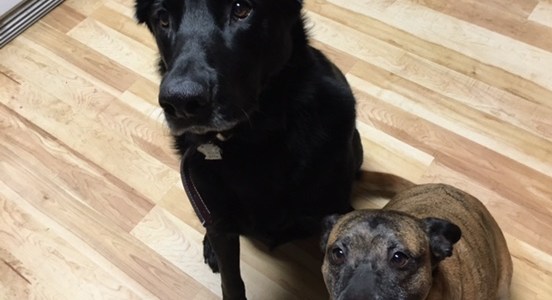
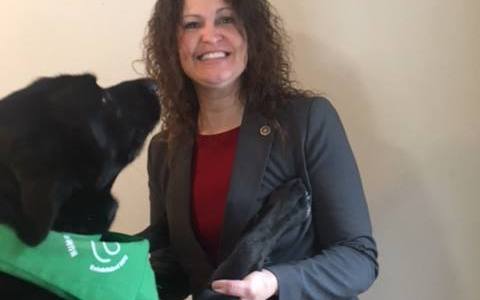
If you’ve ever dated a narcissist, you will identify with this post. If you haven’t ever dated a narcissist, you’re damn lucky. Few experiences make you question your self-worth, sanity, and reason to live more than being “loved” then dumped by a narcissist. I say dumped because they are people who dispose of things and people once they are used up. The first time the narc came to my house, my black lab chewed up his phone charger. Smart dog.

“Narcs” love vulnerable people. You know, widows, the broken-hearted, the poor bastard going through a mid life crisis. And the worst part is they are exactly whom you were looking for. The rescuer. The comedian. The princess. The prince. This is because they are chameleons, changing shades and personalities to be everything you had ever hoped for. Love live music? So do they. Love politics? So do they. And if you like hiding from the rest of the world, they love that best. You will find yourself saying “I can’t believe how alike we are.”

However, the moment you begin to show a sense of self outside the narc’s view, beware. The narc is king and you are merely a subject. Avoid telling truth to power if you want to stay in the narc’s good graces. Otherwise, you will be out on your can. And don’t ever criticize–you will be extracted from their life.

One narc I dated drew me in with promises of intimacy and closeness. We had a long distance relationship, consisting of FaceTime, text messages, and emails. When we did interact in person, we were electric. He was sarcastic and cute, and I really liked him. However, his decades long pot habit had given him the memory of an errant puppy, and when I called him on it he flew into a rage.

The narc often told me to wait in the car when he stopped by a friend’s house, or the store. I thought, What the hell? Is this the 50s? He once turned to me and said, “There’s stuff in the fridge. Go make us a couple of sandwiches.” I started laughing hysterically. He said, “What’s so funny?” I thought he was joking. And yes, I made the sandwiches.

One morning after breakfast in a diner, the narc introduced me to his friend who was thinking of joining the army. I talked to this young man about my stint in the navy and how I went to college and grad school. The narc interrupted and said, “She also sells crack to kids.” On the walk to the car, I said, “Why did you do that?” The narc went bananas! “Can’t you take a fucking joke?” The narc had never finished high school.

I knew we were over when the narc barked an order at me and I said, jokingly, “Quit telling me what to do.” Right there, mid vacation, (we had three days left) he said, “I think we’d be better off as friends.” This from the guy who said we belonged together forever. I walked to the bedroom and started crying.

Over the next three days, the narc and I acted like roommates. He went back to his town, and during a long phone conversation in which we truly broke up, the narc said “Tell everyone this break up was mutual. Don’t put that shit on FB. You will look like an immature drama queen.” Would you believe I listened to him?

Luckily, the narc and I only dated a few months, and yet, I was reeling. I started running long distances and imagined his lying face beneath my right foot every time it hit the pavement. Ahhhh. Ahhh. Ahhh. I spent a lot of time crying that December.

After our mutual friends learned about the break up, they told me, “He’s a huge loser. We couldn’t figure out why you were with him.” I rolled my eyes. I fell for him because I had lost my father and the narc came to his funeral. I was so tuuched. We started texting, he called me “Baby” (puke), and the rest is history.

The red flags were abundant and waving. I should have known the minute Gus chewed his phone cord that the narc was not accepted by my very smart dog. Looking back, I see this as a wonderful learning experience. My antenna are up, and I have taken a haitus from dating. Until then, I will hang with my dogs.

The Nerd in Disguise

In the ’80s, when I was coming of age, MTV was everything–I loved the thrift-store fashions of Cyndi Lauper, the fluffy skirts, zip up boots, and torn stockings. She looked so cool. But I went to a catholic school where we had to follow a dress code: blouses, slacks and/or skirts (not too far above the knee), no stirrup pants, and dress shoes. The most rebellious I could get was popping my collar.

I had grown up as a tomboy, two years younger than my brother, and because we were not rich, my father dressed me in “Tony’s” hand-me-downs. Until I was about five, I believed I was a boy. My father let me walk around the house with no shirt on, Tony and I had fist-fights with kids on the playground, and I only wore pants.

My father remarried when I was six, and my stepmother introduced me to a hairbrush, ruffled panties, dresses, tights, and patent leather shoes. It was not a smooth transition. When she brushed my knotted hair, I wailed and she yelled. And when I hung upside down from a tree limb while wearing a dress, consequently showing my flowered underwear, she told me to get down.

Looking back, I realize my stepmother was a trend follower. She wore T-shirts with sayings on them, high-priced designer jeans, and used top-of-the-line makeup and hair products. She bought school clothes for my brother and me at the very uncool Sears store in the mall and sneakers from a place called Philadelphia Sales. Cheap!

Of course, in high school, I was desperate to fit in and begged my stepmother to buy me Izod polos, designer jeans, and elf boots. She took me to outlet malls where they had “slightly damaged” Izod clothing and I got my polos. I borrowed elf boots from my friend, and was grateful for being a cheerleader who got to look cool in my uniform on game days.

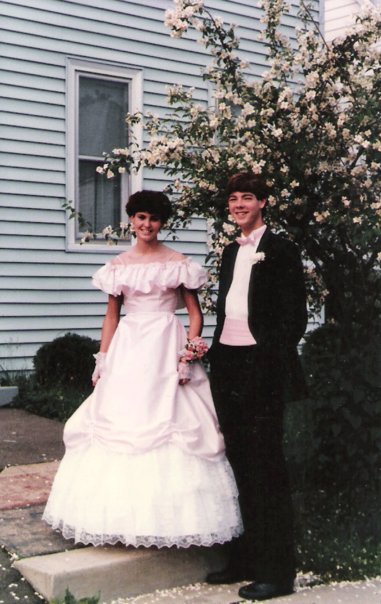
Luckily, my stepgrandmother bought me Forenza sweaters and wide wale corduroys from the Limited, and Gloria Vanderbilt designer jeans. And for my senior prom, my father gave me an unlimited price tag to buy any dress I wanted–a mauve Southern Belle dress and finger-less gloves.

10400218_46458813186_3064_n

One of the things I liked about 80s fashions were they were influenced by the late 50s and early 60s fashions–saddle shoes, penny loafers, poodle skirts and angora sweaters worn over a blouse with a Peter Pan collar. When the GoGos appeared on MTV with their short hair styles and blouses, my father thought they were a 50s band.

As a woman who will turn 50 this year (yay!) I wear what I like to call “classic” fashions. Collared blouses, slacks, and shoes that don’t go out of style. This is not necessarily to make a statement; I think it’s because growing up poor taught me to be thrifty. I want my clothes and shoes to last. I shop at Goodwill and second-hand stores. I visit Nordstrom Rack, not Nordstrom. And if I think a piece of clothing I buy won’t last at least a decade, I usually put it back on the rack.

Some people always seem to know which trends are coming. The messy bun, big sunglasses, eyelash extensions, yoga pants. If it weren’t for my grown daughters, I might never know what was “in style.” I work in a professional office, so I wear dress clothes, but I feel like a nerd in disguise. I’ll leave the trends to the people who have the time and energy to follow them.

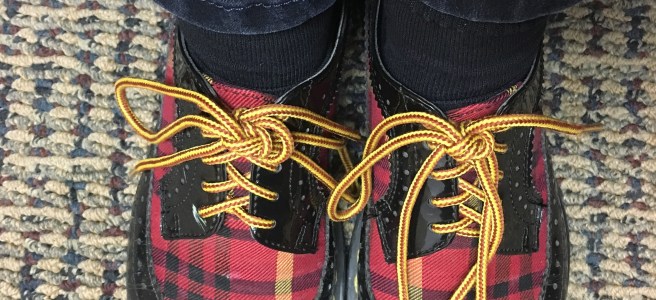
I’m deeply grateful that my father dressed me in boys’ clothes. I know I will never be a princess. Today I’m wearing a pair of Doc Marten saddle shoes I bought at a second-hand store for $35. I love telling people how inexpensive they were. I get many compliments on them. I once got a snide comment, but that woman and I hardly talk anymore.